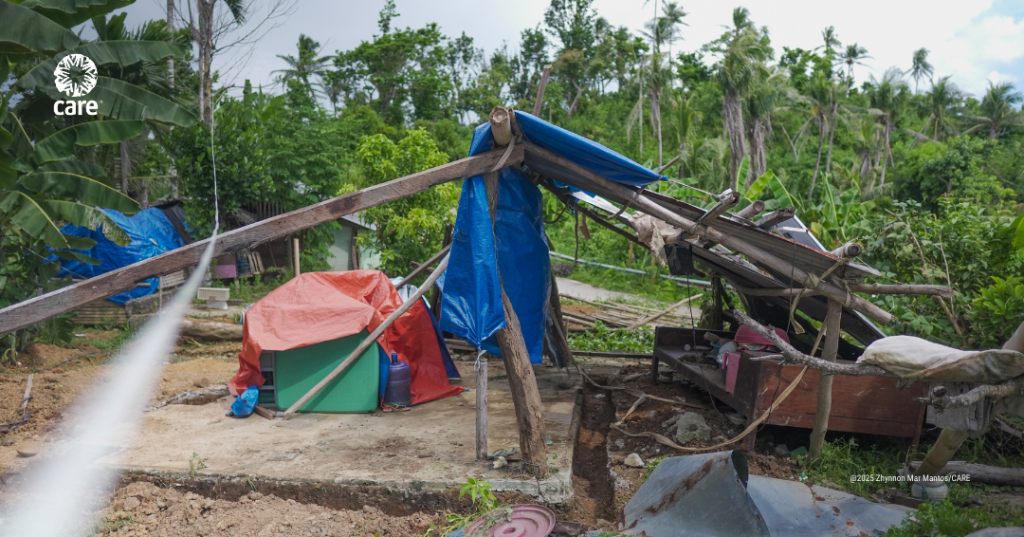
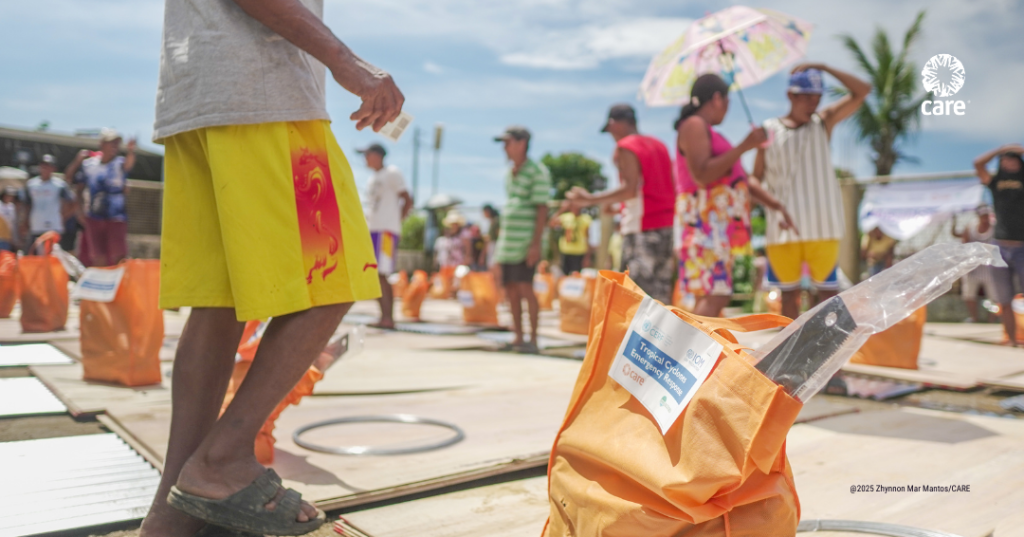
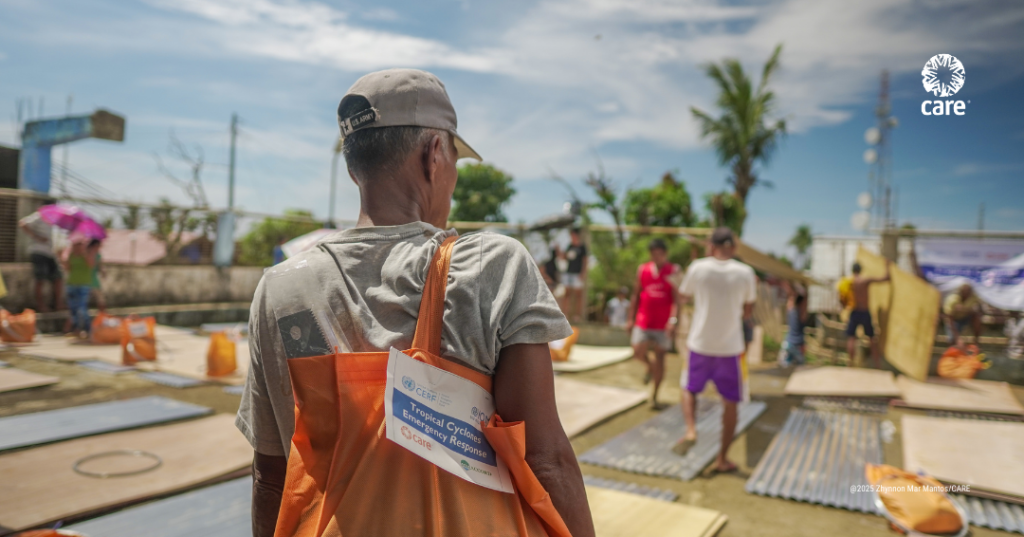
Manila, Philippines (September 27, 2025) — CARE Philippines and its partners are expanding their emergency assistance after Typhoon Opong made landfall, compounding a crisis for communities still reeling from two previous storms and an enhanced southwest monsoon. According to the National Disaster Risk Reduction and Management Council (NDRRMC), the successive weather events have affected 520,000 families, and displaced 1,000,000individuals, across 15 regions.
CARE’s emergency response teams are working closely with local partners, including the Humanitarian Partnership Platform and ACCESS consortium, to rapidly assess the most urgent needs and are preparing to distribute Emergency CARE Packages™.
“We are acting early to reduce risk and protect lives,” said Reiza S. Dejito, Country Director of CARE Philippines. “Side by side with local partners, we’re ensuring timely, safe, and dignified support—placing those most at risk in last-mile communities at the center of our response: women and girls, older people, persons with disabilities, and indigenous communities.”
Some of the most urgent needs identified include food assistance and livelihood support as flooded fields, damaged boats, and lost daily wages hit families hardest, particularly at-risk and indigenous upland communities. Safe water, hygiene supplies, proper sanitation, and emergency shelter with essential household items are needed in crowded evacuation centers, alongside protection measures (such as well-lit, separate spaces and services for women, and girls; psychosocial support; and dignity kits). Learning is disrupted, requiring temporary learning spaces and basic materials so classes can resume.
“Our teams are ready and coordinating with authorities, partners, and community leaders to identify the hardest-hit areas quickly and get assistance where it’s needed most,” said Jessan Catre, Humanitarian, Disaster Resilience and Peacebuilding Coordinator, CARE Philippines.
Each year, multiple tropical cyclones and monsoons affect the Philippines, driving recurrent flooding and disruptions to essential services. The impacts of these back-to-back, interacting hazards make recovery challenging for many communities, particularly those in geographically isolated and disadvantaged areas.
CARE Philippines has provided humanitarian and development support since 1949. As one of the most disaster-prone countries globally, the Philippines faces significant challenges, and CARE remains at the forefront of delivering life-saving support to communities most in need. According to the World Risk Index report, the Philippines has been ranked as the country most at risk for disasters for four consecutive years. This context underscores the critical importance of CARE’s work in disaster preparedness and strengthening local capacity.
Note to Editors:
The Emergency CARE Package™ is a lightweight, 20 kg kit with 39 essential items to help a family of four for one month. It includes supplies for shelter, clean water, hygiene, and cooking.
The kit was successfully tested in Nepal after an earthquake, where it received positive feedback. CARE plans to provide the packages to communities in the Philippines, Bangladesh, Nepal, and the Southern African Region, reaching 6,200 people.
For media inquiries, please contact:
Mary Therese L. Norbe, CARE Philippines Communications Specialist
The landmark legislation, Republic Act No. 12287, paves the way for proactive government response, protecting people before floods, typhoons, or other hazards hit
In a historic move to save lives and protect at-risk communities, the Philippine government has passed the Imminent Disaster Bill into law, establishing a national framework for anticipatory action – measures taken before a hazard hits or before its worst impacts are felt. The law mandates that government agencies act before impacts peak: to pre-position supplies, organize preemptive evacuation, or release early cash or in-kind support.
“This is a turning point for the Philippines: from reacting after a disaster to protecting people before it strikes. The real test is in implementation, and we stand ready to work with government and communities to make anticipatory action a reality nationwide,” says Reiza Dejito, Country Director of CARE Philippines, the organization leading the European Union Humanitarian Aid-funded ACCESS Project, which implements anticipatory action initiatives.
“With this new law, the government can now officially lead anticipatory actions and utilize state resources to save lives and protect livelihoods. The era of waiting for the most vulnerable to experience the full brunt of a disaster before help arrives is, we hope, coming to an end,” says Lot Felizco, Executive Director of Oxfam Pilipinas, an ACCESS consortium member.
Centering Community Voices
People most affected by typhoons, floods, and other hazards are now covered by a clear legal mandate for early action. Civil society organizations, including ACCESS members, helped ensure the law is grounded in the realities of communities frequently affected by disasters, amplifying local voices to inform policy and keeping the law steadfast to its core purpose: to save lives, protect livelihoods, uphold dignity, and adhere to the ‘do no harm’ principle.
“For the longest time, our communities have been on the frontlines of climate change, waiting for the next storm to take everything from them. This law gives us hope and a fighting chance. It is a testament to what is possible when we work together towards a common goal of resilience,” says Esteban Masagca, Executive Director of People’s Disaster Risk Reduction Network (PDRRN).
Adds Sindhy Obias, Executive Director of Assistance and Cooperation for Community Resilience and Development (ACCORD), “More than anticipating disasters, the law recognizes the strength and wisdom of Filipino communities who have long been the first responders. This legal foundation strengthens our collaboration with government, partners, and communities so that preparedness is a guaranteed right for every family at risk.”
‘No One Left Behind’
The law helps broaden support for women, girls, older adults, people with disabilities, and others who often face barriers to aid.
“Disasters affect girls differently and disproportionately,” says Pebbles Sanchez-Ogang, Executive Director of Plan International Pilipinas. “The new law enables earlier action to protect girls and meet their specific needs before disasters strike, helping ensure that every child—especially every girl—is safe, empowered, and resilient in the face of typhoons and other emergencies,” she adds.
Says Melanie Ruiz, Country Manager of Humanity & Inclusion Philippines, “Through this new law, we continue to promote inclusive anticipatory action, enabling meaningful participation of people with disabilities, older adults, women, children, and other marginalized groups in disaster preparedness, to ensure no one is left behind.”
Enabling Proactive Measures
The new law provides a clear legal framework for government agencies at all levels to:
Pre-position goods and supplies in areas forecasted to be hit by a hazard
Implement pre-emptive evacuations to ensure citizen safety
Distribute cash or aid assistance to families so they can meet basic needs without resorting to negative coping strategies
Secure assets and livelihoods, such as boats, livestock, and equipment, minimizing economic loss
This proactive approach protects development gains and breaks the cycle of poverty exacerbated by repeated disasters. “This legislation is a milestone that reinforces ongoing efforts to integrate early action, preparedness, and disaster risk reduction into both humanitarian and development programs,” says Suresanathan Murugesu, Country Director of Action Against Hunger Philippines.
Proven Anticipatory Action Activations
Since 2023, ACCESS has been delivering anticipatory action support to the most at-risk, difficult-to-reach communities in Mindanao and across the country, covering hazards such as floods and typhoons, as well as conflict. This meant communities had access to essentials such as food and water, could safeguard personal belongings and livelihood tools, and move to safety before impact.
Consortium advocacy has also strengthened local adoption: In 10 barangays in Basilan and Sulu, barangay councils passed resolutions adopting anticipatory action and rapid response mechanisms introduced under ACCESS through Save the Children Philippines, Nagdilaab Foundation, and Notre Dame of Jolo College. Communities designed the plans to reflect local risks and realities and tested them through a simulation drill, advancing more inclusive, child-sensitive disaster response and preparedness.
During the 2024 El Niño in the Bangsamoro Autonomous Region in Muslim Mindanao (BARMM), SUPREME BARMM, another EU Humanitarian Aid-supported initiative led by Oxfam Pilipinas, activated the country’s first anticipatory action for drought. Communities in the Special Geographic Areas (SGAs) received critical cash, in-kind, and information assistance before the drought peaked, helping to reduce its impact. The project also activated anticipatory action ahead of severe floods in Cotabato City between 2020 and 2023.
A Call for Collective Action
While the passage of the law is a win, its rollout will require close collaboration between government, civil society, and communities in hazard-prone areas. ACCESS consortium members are committed to ensuring that efforts remain grounded in the lived realities of those most affected.
About ACCESS
ACCESSis multi-year, multi-sectoral humanitarian and disaster preparedness initiative funded by European Union Humanitarian Aid. It serves the most affected, underserved, difficult-to-reach communities in the Philippines, where natural hazards, conflict, recurrent displacement, and intensifying climate-related risks continue to threaten lives and livelihoods. Since 2023, the project has helped more than 200,000 people.
ACCESS is implemented by a consortium of 14 local and international organizations: ACCORD, Action Against Hunger Philippines, CARE Philippines, Community Organizers Multiversity (COM), Humanity & Inclusion Philippines, Integrated Mindanaons Association for Natives (IMAN), Kadtabanga Foundation for Peace and Development Advocates, Mindanao Organization for Social and Economic Progress (MOSEP), Oxfam Pilipinas, People’s Disaster Risk Reduction Network (PDRRN), Plan International Pilipinas, Save the Children Philippines, United Youth for Peace and Development (UNYPAD), and United Youth of the Philippines – Women (UnYPhil-Women).
For media inquiries, please contact:
Tanya Mariano
Communications Specialist – Humanitarian, Disaster Resilience, and Peacebuilding Unit
MANILA, PHILIPPINES (September 20, 2025) – CARE and its local humanitarian partners are on high alert as Tropical Cyclone Nando (internationally known as Ragasa) threatens to bring destructive winds and torrential rains Central and Northern Luzon. The cyclone is anticipated to strengthen into a Super Typhoon by Monday, September 22. Emergency response teams are on standby to conduct rapid needs assessments and deliver immediate, life-saving assistance to the communities expected to be hardest hit.
“Our immediate concern is for the safety of families in the typhoon’s path, especially those in low-lying, coastal, upland, and indigenous communities. Disasters do not affect everyone equally. We know from experience that women and girls face heightened risks, and ensuring their safety, dignity, and specific needs are met will be at the core of our response. We are coordinating closely with local partners and call for open, direct humanitarian access so local responders can reach last-mile communities with life-saving support.”
— Reiza S. Dejito, Country Director, CARE Philippines
“With PAGASA projecting Super typhoon level for TC Nando, our preparations are moving into the operational phase. Our assessment teams are ready for deployment, and provide emergency supplies for immediate distribution to the most affected families. Our partnerships with community leaders, NGOs and local governments on the ground will be crucial to guide our efforts, ensuring the support we provide is timely and appropriate.”
— Jessan Catre, Humanitarian, Disaster Resilience and Peacebuilding Coordinator, CARE Philippines
For media inquiries, please contact:
Mary Therese L. Norbe, CARE Philippines Communications Specialist Email: marytherese.norbe@care.org, Contact Number: +639199117534
Note to Editors: CARE Philippines has provided humanitarian and development support since 1949. As one of the most disaster-prone countries globally, the Philippines faces significant challenges, and CARE remains at the forefront of delivering life-saving support to communities most in need. According to the World Risk Index report, the Philippines has been ranked as the country most at risk for disasters for three consecutive years. This context underscores the critical importance of CARE’s work in disaster preparedness and strengthening local capacity.
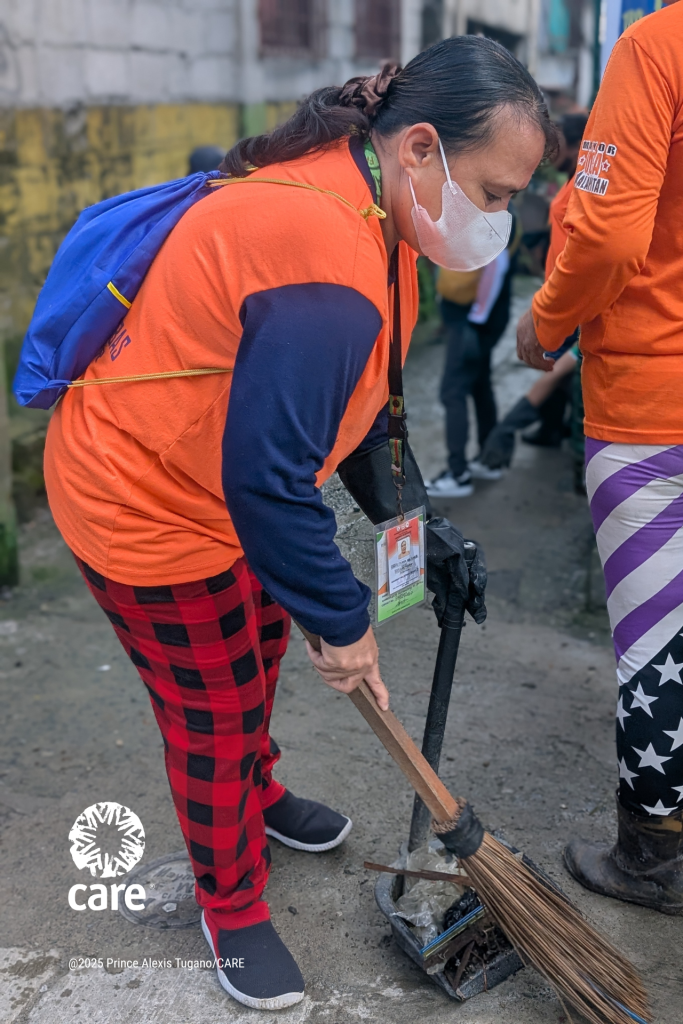
With the rainy season increasing the threat of floods in Caloocan, local communities are taking action to protect their health. Recognizing that standing water in flood-prone areas can increase the risk of diseases such as dengue and leptospirosis, residents came together to ensure their neighborhoods were clean and safe.
The two-day, community-led effort resulted in cleaner and safer public spaces across two barangays. On August 28, approximately 63 volunteers and residents in Barangay 178 took part, and their dedication inspired more than 50 others to join a similar activity in Barangay 186 the following day.
Photo: A woman volunteers sweeps trash from a street in Caloocan City as part of the clean-up drive.
The community’s initiative was supported by the SHIELD Project, a partnership between Pru Life UK and CARE Philippines. The project team provided cleaning materials such as dustpans, brooms, garbage sacks, and wipes to aid the volunteers’ work. To further promote public health, the team also distributed Information, Education, and Communication (IEC) materials on dengue prevention and provided mosquito repellent to residents.
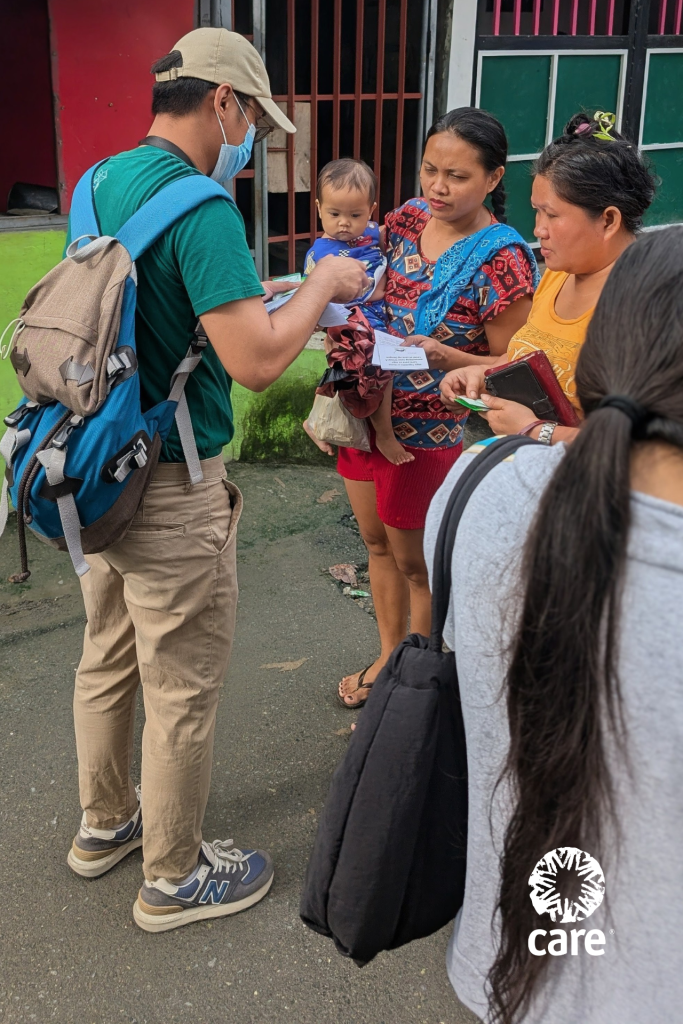
CARE staff partnered with community volunteers to provide residents with information about health risks and prevention.
“These clean-up drives are successful because the community is directly involved. When people take ownership of their environment, the results are more lasting,” said Prince Alexis Tugano, CARE’s project health officer with the SHIELD Project. “We are also grateful for the strong partnership with the local government, whose support is essential in making these activities possible.”
About the SHIELD Project
SHIELD (Sustainable Health Interventions for Eradicating Leptospirosis and Dengue) is a project of Pru Life UK and CARE Philippines, funded by the Prudence Foundation through the Climate and Health Resilience Fund.
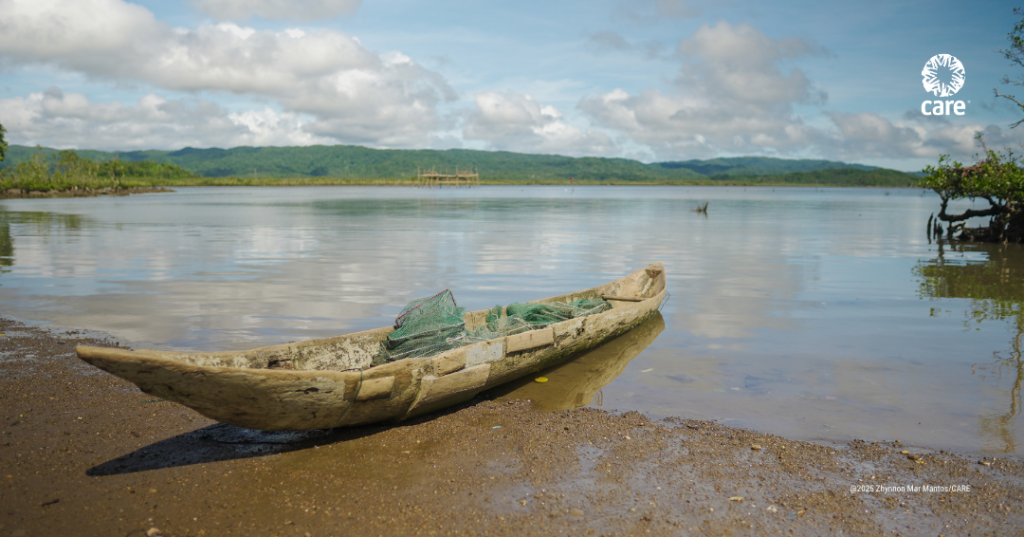
For Imelda, life in Panganiban, Catanduanes, is tied to the sea and the soil. Located directly in the country’s typhoon belt facing the Pacific Ocean, the province is known for its “howling winds” brought by typhoons. For residents, this means life is a constant balance between the calm seasons of work and the ever-present threat of the next storm.
Photo: The shores of Panganiban in a moment of peace. On days like this, the calm sea is a lifeline, offering a treasured opportunity for work and rebuilding before the next storm.
At 52, Imelda’s days are shaped by the rhythm of the tides and the turn of the seasons as she supports her family through fishing and farm work. Lacking her equipment, she rents fishing gear, her livelihood dependent on both the availability of tools and the temper of the ocean. When the sea is harsh, there is no work and no income.
Imelda shares a home and a responsibility with her sister, Marife. Together, they are part of a close-knit network of relatives—five families who support one another through shared meals and daily challenges. When Typhoon Pepito struck in November 2024, Marife’s children were with them, huddled together as the storm unleashed its fury.
The wind tore at their roof until the entire house collapsed, flattened to the ground around them. The family ran through the storm to the safety of the nearest church. When they returned the next day, only debris remained where their home once stood.
“That was years of our life,” Imelda shared. “Every time the work was steady, I would buy a few more materials. We built it piece by piece. To see it all gone in an instant… it is difficult to accept.”
Photo: A powerful reminder of the journey. These are the remains of the temporary shelter Imelda built from scraps after Typhoon Pepito. It was a crucial first step that led to the permanent, sturdier home her family lives in today.
Despite the loss, Imelda took the lead. She organized her family to scavenge for wood and scraps, anything that could be used to build a temporary shelter. A private foundation provided galvanized iron sheets and nails, which they added to their collection of materials. For two months, they lived in the shelter they had constructed, a constant reminder of their loss.
The local government provided cash assistance, which helped them buy food and other immediate necessities. But with her nieces and nephews in school, the money stretched thin. She wanted to return to fishing to help with their education, but the storm had destroyed most of the boats and gear she used to rent. The path to recovery seemed impossibly steep.
With support from the United Nations Central Emergency Response Fund, United Nations International Organization for Migration, and CARE Philippines, she and her sister used the shelter repair kits and cash assistance not just to rebuild, but to build back stronger. They purchased cement and cable wires, investing in a solid foundation designed to withstand future storms.
Photos: Shelter repair kits with essential building materials are now in the hands of families working to recover and rebuild their community.
With this, Imelda and her family did more than reconstruct a house; they built a safer home, which is a testament to their resilience and their determination to create a more secure future.
San Jose, Rodriguez, Rizal — On the afternoon of July 21, Maribel Bernardo stood at the doorway of her home, watching as the river crept up the street. The rain had been falling for days, but by 2 p.m., the floodwaters had reached her knees. That was when she knew it was time to leave.
“There was no warning from the barangay,” said Maribel, 49, a mother of six. “We just looked outside and realized we didn’t have any more time.”
She and her children left on foot, barefoot and soaked, carrying what little they could. Her husband stayed behind to try and protect their home, as many men in the community did.
After being turned away from one shelter, Maribel’s family found space at San Jose Elementary School, where hundreds of other displaced families had gathered. Every classroom was full, and her family ended up in a room with six others, laying out thin mats on the floor of their cramped new living space.
Among those sharing the room is Claudine Miranda, 30, Maribel’s neighbor and close friend. She also fled with her three children as the water rose around their home. Her husband, a construction worker, has been out of a job since the typhoon shut down work sites.
Conditions at the evacuation center have become increasingly difficult. With so many families in one room, there is little space to move, much less find privacy or rest. The lack of security is a constant worry.
“There are men we don’t know walking around the hallways,” Maribel said. “Our daughters are afraid, and honestly, so are we.”
This fear is a common reality in emergencies. In crises, women and girls face greater risks to their safety. Overcrowded evacuation centers that lack privacy, functioning locks, or separate, well-lit toilets can heighten their exposure to harassment and violence against women and girls. Addressing these protection needs is not an option, but a critical part of any effective humanitarian response.
The support that came was also inconsistent. Initial relief included porridge and a small pack with two kilos of rice, a few cans of sardines, and instant noodles. Since that first day, however, assistance has been unreliable.
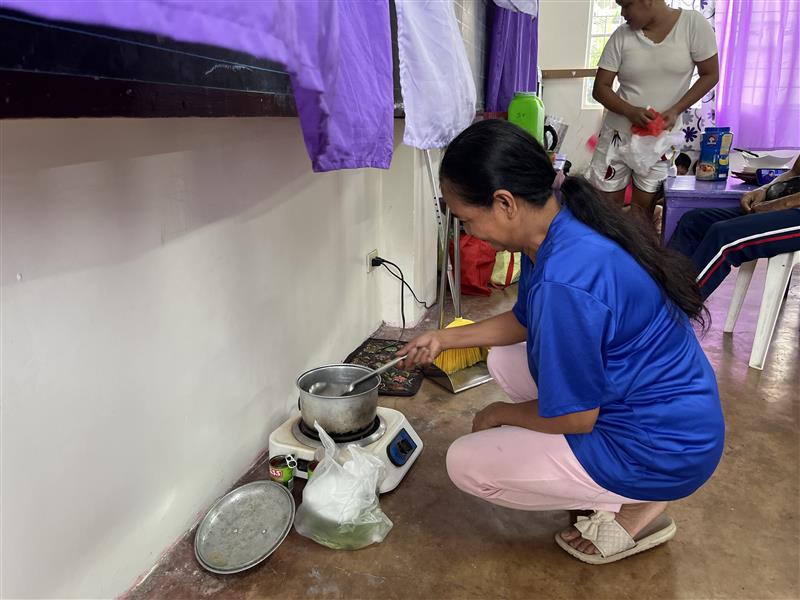
Maribel cooks sardines inside their room at the evacuation center.
“Rice is what we need most,” said Claudine. “Even when we have nothing else, we can make rice last.”
But relying on uncooked rations is not enough. The lack of cooking space and a shortage of fresh food creates an immediate need for warm, complete meals to prevent malnutrition, especially for children and the elderly. To fill this gap and provide for her own family, Maribel started selling boiled bananas, fishballs, and coffee around the evacuation center.
Their husbands, both without income, try to make repairs to their damaged homes with salvaged materials. Still, returning feels like a risk neither family can afford, not with the river just steps away and the rainy season far from over.
“If we had a small push, even a little support to restart our work, a small grant or some tools, we wouldn’t be sitting here waiting for assistance,” said Claudine, highlighting the desire to rebuild.
Maribel nodded in agreement. “We’re not asking for much,” she said. “We just want to go home, feed our children, and know they’re safe.”
For families like theirs, the disaster did not end when the rain stopped. Recovery remains out of reach, and as the days in the evacuation center stretch on, so does their uncertainty.
To better understand the situation in the community and guide a more effective response, CARE Philippines and the ACCESS Consortium are assessing the damage and speaking with affected families in Rodriguez, Rizal, to identify their most urgent needs after the flooding brought by Severe Tropical Storm Wipha and the southwest monsoon.
Disaster Response, Featured Stories, Latest News & Stories
Charmine Rudolfo and Jay Vallestin, both 25, live with their two children in San Antonio, Panganiban, Catanduanes. For six years, they have built a life near the sea. Jay fishes for shrimp and crabs, while Charmine takes care of their children and home.
Living close to the sea has its costs, especially when storms and typhoons strike. When Typhoon Pepito hit, strong winds and rising waves destroyed everything. Their home, made of plywood and thatched nipa leaves, was swept away. “We lost everything to the sea,” Charmine said.
For a month, the family stayed in an unused space in their village leader’s house. They relied on government food support for their daily survival. Jay would go out to sea for hours, hoping to catch enough to feed the family and earn a little income. Sometimes, he would return with nothing. The uncertainty of each day weighed heavily on them.
Photo: Jay shows the juvenile crabs he caught that were packed and ready to be sold to mud crab growers.
Their children still feel scared when it rains heavily. The sound of strong winds or pounding rain brings back memories of the typhoon. As parents, Charmine and Jay find this heartbreaking. They want their children to feel safe again.
Determined to rebuild, they borrowed money to buy lumber and hire a carpenter. Though the interest was high, they took the loan because they had no other option. However, the funds were still not enough. They used scrap GI sheets for walls and gathered sand and pebbles from the shore to create a temporary floor.
When CARE, through the UNCERF-funded emergency response, arrived in their community, they assessed the damages and the needs of the most affected people. Charmine and Jay’s family qualified for shelter repair kits and multi-purpose cash assistance. These resources gave them the support they needed to begin rebuilding their home with dignity and hope.
With the materials and cash assistance, they began rebuilding together. Jay helped the carpenter after fishing trips, and Charmine hauled sand and gravel.
“We worked together to save on labor costs,” Charmine said.
Today, their house is still a work in progress. The walls need to be completed with plywood and properly braced. The floor remains unfinished, but they plan to buy cement to make it sturdier and safer for their children. The kitchen also still needs to be built, so Charmine can once again cook meals in a space of her own. The roof also needs to be reinforced to withstand strong winds. With the rainy season usually beginning in June, they are doing their best to prepare and protect their family.
Photo: Jay readies the crab traps in preparation for another fishing trip while Charmine cleans the catch for selling.
“It is small, but we have big dreams,” Jay said. “We are working hard so we can make it stronger and one day move to a safer place.”
At 63 and 64 years old, Linda and Avelino delos Santos have spent their lives working hard in the village of San Rafael, Bagamanoc, Catanduanes. Linda ran a small store from their home. Avelino worked on nearby abaca and coconut farms, fished when he could, and took construction jobs when they were available.
Their income was never steady and depended on the seasons—a challenge that became harder with age. “Our daily life is hard,” Linda said. “We have to stretch every peso just to get by.”
When Typhoon Pepito hit, it destroyed what little security they had. The storm tore off the roof and walls of their home, forcing them to evacuate. They used a tarp as a temporary roof, but it leaked every time it rained. The typhoon also wiped out their sources of income. The farms were destroyed, leaving Avelino without work. The sea offered little fish, and Linda’s customers no longer had money to spend. Food prices in the market rose sharply.
“We couldn’t even afford vegetables—they cost as much as meat,” Linda said.
Relief came when CARE and its local partner, TABI, supported by the Gates Foundation, delivered essential food and household supplies. The impact was immediate.
“We had enough food to last more than two months, and we were glad to share some with my siblings,” Linda said.
With food no longer a daily concern, the couple could focus on their health and begin repairing their home.
Featured Stories, Food & Nutrition, Latest News & Stories
For Liezel, 33, and her husband, Mark Anthony, 35, life in their village in Pandan, Catanduanes, was built on hard work. As a cook at a nearby resort and a construction worker, they earned a decent income together, enough to provide for their two children.
Their stable life was turned upside down when Typhoon Pepito struck. The storm’s powerful winds tore the roof and walls from their house. With their home destroyed, the family had to stay with Liezel’s sister for over a month.
The typhoon took more than just their home; it took their jobs. It damaged the resort where Liezel worked and halted all construction projects in the area. With no income, the family relied on government food aid to survive. After a month, the resort reopened, but with only Liezel working, the family struggled to afford enough food. Her husband was not able to get back to work until February.
“It was difficult because this was the first time we experienced a typhoon that destroyed our house and stripped our savings,” Liezel said.
The experience also left a lasting impact on her children. “Every time it rains hard, they get scared,” she shared.
In March, CARE and its partner TABI, with support from the Gates Foundation, came to their village with food, kitchen items, and sleeping materials. This support which included 75 kilos of rice and other food items, like chicken, was essential to keep going.
Photo: A family waits for a boat to carry their food, kitchen items and sleeping materials to their village. The food could last a family of five for 2-3 months while they recover their livelihood.
“I saw how my children were smiling from ear to ear, especially when I fried the chicken. It was their favorite meal, even before the typhoon,” she said.
With enough food to last their small family for the next three months, Liezel felt a sense of relief she hadn’t felt in months.
“As a cook, I always worry about my children’s food,” she said. “And I was so happy that they got to eat well again.”
This support provided the stability her family needed to get back on their feet.
Featured Stories, Latest News & Stories, Stories of Change
Corazon Malano, 72, lives in Baang, Catigbian, Bohol, where farming is a way of life. At an early age, she learned the value of hard work on her family’s coconut farm. When she started her own family, coconut farming became her main source of income. Since 1975, she has relied on coconut farming to support her family, send her children to school, provide food, and invest in small ventures, such as raising livestock and growing rice.
For nearly 50 years, her life was shaped by the rhythm of the land and the coconut harvests that her family depended on. “Coconut farming is dependable and brings a reliable income,” she says.
Life as a coconut farmer has always had its challenges. Because the price of copra changes, some seasons were good, while others barely provided enough to get by. In good times, she could earn up to 10,000 pesos from her 200 coconut trees, but during bad times, she had to find other ways to make ends meet. Corazon never considered giving up, despite these struggles.
Then came December 16, 2021. Typhoon Odette, one of the strongest typhoons to hit the Philippines, swept through her community. Its strong winds uprooted coconut trees, destroyed homes, and left entire communities uncertain about the future.
For Corazon, the loss was personal. “It’s like saying goodbye to a family member who has helped us come this far,” she says. The loss was immense, not just financially, but emotionally. Coconut farming had built her life, and now she wondered how to start over.
With most of her coconut trees gone, the future seemed bleak. She worried that recovery would take years and feared that she and other coconut farmers might never get back what they lost.
A Renewed Sense of Hope
Then came the RISE Coco (Recovery Intervention for Severely Affected Coconut Farming Communities of Bohol by Super Typhoon Odette) Project, which brought immediate support and a clear plan for long-term recovery. Through the project, she was able to replant coconut trees and rebuild her farm.
The project’s training was especially helpful. She attended sessions on Good Agricultural Practices and learned new techniques to help her farm succeed. The lessons introduced lasting methods to make her farm resilient in the future. She learned about standard planting practices, like the proper spacing between trees to ensure healthy growth. She also learned how to properly use organic fertilizers to give her trees the right nutrients at the right time.
“I was happy because this project didn’t just help us recover our farms, it also gave us knowledge on how to improve our practices,” she says. “Now, we know how to plant better, how to take care of the trees, and how to ensure that they grow stronger against strong winds and heavy rains.”
Community and Lasting Change
The RISE Coco Project’s Livelihood Support Program also brought much-needed changes. The Baang Organic Small Coconut Farmers Association (BOSCOFA), which Corazon leads, focused on producing organic fertilizer and trading copra. This program gave them another way to earn money while waiting for the new trees to grow. This allowed farmers in the organization to improve their financial situation.
The livelihood support program also provided training to help her and her fellow farmers develop the skills needed to keep their collective business going. She learned how to produce and market organic fertilizers and ensure their group’s financial stability.
“This was a huge help for us,” Corazon shares. “Before, our organization was barely active. But with this program, our members became more engaged. We saw hope, and we worked together to make things better.”
The project’s effects were felt throughout the community. Farmers who had been unsure about the future now had something to work toward. The organization became more active and united. Corazon saw a new sense of purpose among her fellow farmers. Where there was once uncertainty, there was now determination.
For Corazon, the project was not just about recovering lost trees; it was about rebuilding confidence in the future of coconut farming. It gave them the tools to recover and reminded them of their strength as a community.
“The RISE Coco Project has significantly impacted our lives,” she says. “It did not only encourage us to rehabilitate our farms. It also gave hope to the farming families in our community.”
Now, when Corazon looks at the young coconut trees on her farm, she sees more than a source of income. She sees a future where farmers like her are better prepared, more knowledgeable, and more resilient. The road to recovery is still long, but with the right support and a willingness to keep going, she knows they are on the right path.
Story and Photos: Hannson Namoc
The RISE Coco project is a partnership anchored on a global agreement between Cargill and CARE International to work together to implement programs that would rehabilitate livelihoods impacted by disasters, support recovery and promote food security of affected farming communities. It is being implemented by CARE Philippines and its partner, the Cebubohol Relief and Rehabilitation Center.