Women and girls in the Philippines are in need of your support.

DOH, CARE Philippines explore digital learning for community health workers

  • CARE Philippines
  • Blog, Featured Stories, Latest News & Stories

The Department of Health (DOH) and CARE Philippines recently held a round table discussion to study if the HEAL Hub app can become an official learning platform for Barangay Health Workers (BHWs) across the country.

The meeting brought together key representatives from DOH offices, including the Knowledge Management and Information Technology Service (KMITS), the Bureau of Local Health Systems Development (BLHSD), the Disease Prevention and Control Bureau (DPCB) Cancer Division, and CHD CALABARZON, and the PhilHealth.

The discussion focused on the viability of the DOH adapting the app to provide standardized training on critical health issues, including new modules on cancer awareness. Unlike traditional information systems, the HEAL Hub is a digital learning tool that allows BHWs to watch educational videos and complete lessons at their own pace, even in areas with limited internet.

Key highlights from the discussion:

  • Scaling through Partnership: CARE Philippines shared plans to transfer the HEAL Hub to the DOH through a deed of donation. This ensures the government can manage and update the app to reach more health workers.
  • Support for Frontline Workers: Representatives from the participating bureaus explored how the app’s animated lessons and offline features make learning more engaging and accessible for BHWs.
  • National Alignment: The group discussed how to align the app’s content with the BHW Reference Manual and national health goals, ensuring every community receives accurate and consistent health advice.

By exploring this digital partnership, the DOH and CARE Philippines aim to provide community health workers with the best tools to further enhance their capacity. These tools will help BHWs increase their confidence and knowledge, allowing them to provide quality health care and accurate health information to the wider community.


.


.


.

Scaling through Partnership: CARE Philippines shared plans to transfer the HEAL Hub to the DOH through a deed of donation. This ensures the government can manage and update the app to reach more health workers.

Support for Frontline Workers: Representatives from the participating bureaus explored how the app’s animated lessons and offline features make learning more engaging and accessible for BHWs.

Rapid Humanitarian Analysis: Cebu Earthquake

  • CARE Philippines
  • Featured Stories, Humanitarian, Latest News & Stories, Reports & Publications, Resources, Women and Girls, Women and Girls

On September 30, 2025, a powerful 6.9-magnitude earthquake struck northern Cebu, damaging homes, disrupting livelihoods, and displacing thousands of families in Daanbantayan, Medellin, and San Remigio. Many people are still living in temporary shelters and facing challenges in accessing clean water, food, and health services.

CARE Philippines, through its SAFER and ACCESS projects, carried out a Rapid Humanitarian Analysis (RHA) from October 7–14, 2025. The assessment looks at how the earthquake affected women, men, children, and other at-risk groups, and identifies urgent needs and opportunities for recovery.

The report highlights priorities such as safe shelter, clean water, health and psychosocial support, and livelihood recovery—while promoting inclusive solutions that restore dignity and resilience.

Read the full report to learn what communities are facing and how we can work together to rebuild lives in northern Cebu: RHA-Cebu-Earthquake.pdf

Stories from the Field: For a mother in Negros, the flood took more than a home

  • Mary Therese Norbe
  • Blog, Featured Stories, Humanitarian, Latest News & Stories, Women and Girls

For Gina Billones, 53, life along the Bago River in Murcia, Negros Occidental, is shared with her two children, ages 24 and 17. They are one of several families settled in a community along the riverside.

Recent flooding in the area caused by the heavy rains by Typhoon Tino (international name Kalmaegi) significantly damaged Gina’s house, forcing the family to evacuate. Since the disaster, they have been relying on food packs distributed by the social welfare office to meet their basic needs.

Access to safe and reliable water remains a pressing concern. The flood overflow contaminated the household’s shallow well, which they typically use for daily needs, making it unsafe. The family must now source their drinking water from a refilling station, at a cost of PHP 135 ($2) per container.

The flood has also interrupted the family’s income. Gina works in the nearby sugarcane fields, but the flooding temporarily halted all work on the plantation. This sudden stop in work affects multiple households in the riverside community, many of whom share a similar dependence on plantation-based labor.

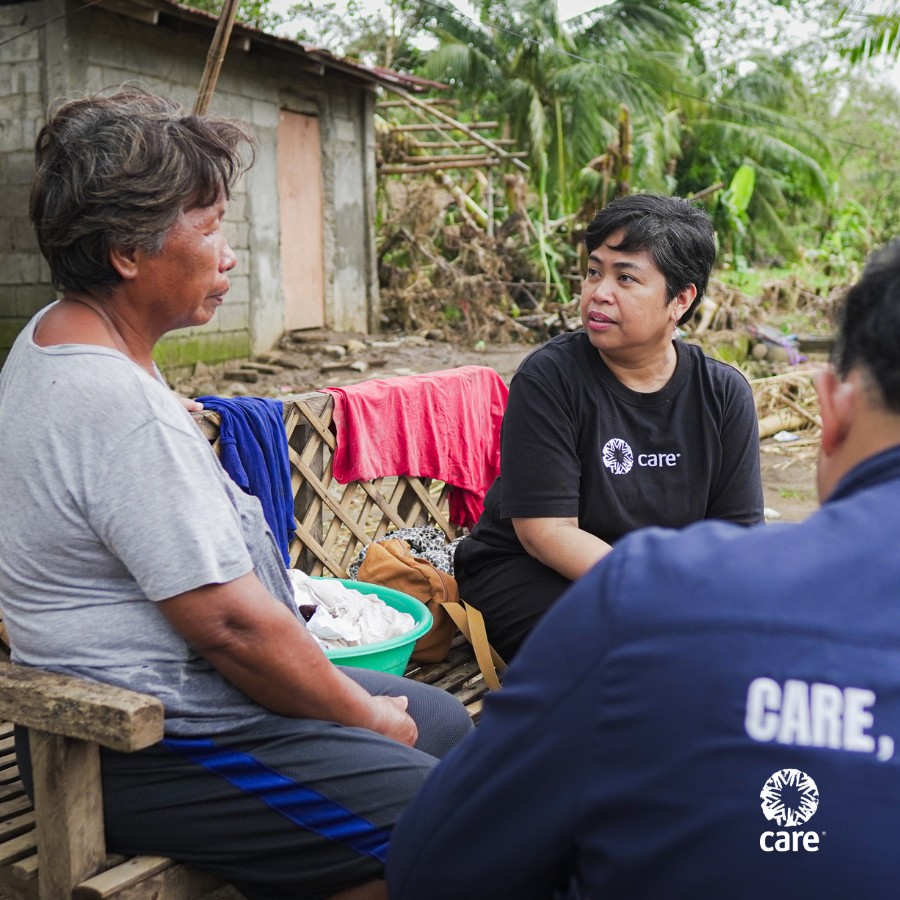
Gina shares her story to CARE Philippines Country Director and her team during their assessment in the community on November 9, 2025.

“We have no income but we have to buy what we need”, she shared.

At present, the family’s priority needs include continued food support, safe drinking water, and materials for shelter repair. The early resumption of their livelihood, or alternative options for earning an income, is essential for them to sustain their daily living and begin recovery.

CARE Philippines is currently assessing the needs of affected communities like Gina’s. The organization is preparing to provide support, focusing on delivering essential items and assistance to help families meet their immediate needs and cope with the effects of the flooding.

Escalating crisis: On the 12th anniversary of Typhoon Haiyan, Philippines braces for another super typhoon

  • CARE Philippines
  • Featured Stories, Latest News & Stories, Press Release

Photo: CARE staff Sandra Bulling talk to survivors of typhoon Haiyan in the Philippines. The typhoon caught the Philippines by surprise by the typhoons size and strength and is believed to be one of the strongest typhoons on record. Thousands have died across a large area of land and CARE are responding with food and shelter material. Photo: CARE/Peter Caton

CARE, Manila, November 8, 2025 – Exactly 12 years to the day after Super Typhoon Haiyan (Yolanda) claimed more than 6,000 lives in 2013, the Philippines is facing another potential super typhoon. CARE Philippines is bracing for Typhoon Fung-wong (locally named Uwan). Forecasters expect it to intensify into a super typhoon just four days after Typhoon Tino devastated the Visayas.

“It is heartbreaking and terrifying that on this day of remembrance for Haiyan, communities are once again forced to flee their homes. We are witnessing an unbroken cycle of destruction that is pushing people to their breaking point,” said Reiza S. Dejito, Country Director of CARE Philippines. “Families in the Visayas have barely started cleaning the mud from their homes after Typhoon Tino, and now they must prepare for Uwan. This is the stark reality of the climate crisis—hazards are becoming so frequent that there is zero time to recover.”

Typhoon Uwan is projected to track towards Luzon. It may make landfall in Catanduanes—an island province that has not yet fully recovered from Super Typhoon Pepito (Man-yi) last year. CARE is deeply concerned for abaca farmers there. Their newly replanted crops take two years to mature and are at high risk from the approaching storm.

Meanwhile, the situation in the south remains critical. Dinagat Islands and Southern Leyte, areas hit first by Typhoon Tino only four days ago, are back under Tropical Cyclone Wind Signals today due to Uwan’s expansive reach.

CARE Philippines is managing a complex, multi-front response. Teams are on the ground providing life-saving aid to flood and lahar survivors in Cebu and Negros from Typhoon Tino. At the same time, we are assessing readiness for Uwan’s anticipated impact in Luzon.


Notes to the editor:

  • Super Typhoon Haiyan (Yolanda) made its first landfall on November 8, 2013. It is the deadliest typhoon in Philippine modern history, with over 6,300 confirmed dead.
  • Typhoon Fung-wong (Uwan) is forecast to rapidly intensify and may reach super typhoon category before a possible close approach or landfall over Catanduanes on November 9.
  • Typhoon Tino, which made landfall on November 4, has already affected over 1.4 million people and displaced more than 600,000.
  • CARE Philippines is responding to these compounded crises through its local partners and the ACCESS Consortium.

Media contacts:

Mary Therese L. Norbe

CARE Philippines Communications Specialist (English, Filipino, Bisaya, Hiligaynon) marytherese.norbe@care.org

CARE responds as Typhoon Tino deepens crisis for earthquake and flood survivors 

For immediate release 

MANILA (November 5, 2025) – CARE Philippines has activated its local emergency teams in Cebu, Negros Occidental, and Eastern Samar to help communities affected by Typhoon Tino (Kalmaegi). The storm has hit areas that were already dealing with other recent emergencies. 

The storm, which made five landfalls across the Visayas, has affected 1,107,819 people and displaced 577,928 as of November 5. The National Disaster Risk Reduction and Management Council (NDRRMC) has also reported 52 people dead and 13 missing. In response to the extensive damage, a State of Calamity has been declared in 53 cities and municipalities in Cebu. 

“Women and girls are once again carrying the weight of overlapping crises,” said Reiza S. Dejito, Country Director of CARE Philippines. “In Northern Cebu, families who lost their homes in the September earthquake are displaced again. Our recent assessment there showed that women were already under extreme stress, holding their families together while living outdoors in fear of aftershocks. This typhoon now adds a devastating new layer of hardship to their struggle. We are seeing similar compound crises in Eastern Samar, with recurring floods, and in Negros, with the threat of volcanic lahars. Our immediate priority is to find out what people urgently need for shelter, clean water, and food.”  

Typhoon Tino passed through several areas already facing emergencies. In Northern Cebu, the storm hit communities still recovering from the M 6.9 earthquake on September 30. In Eastern Samar, it is affecting communities that have already endured recurring floods from recent storms, monsoons, and the shearline. In Negros Occidental, heavy rainfall has triggered high-risk warnings from PHIVOLCS for lahars (volcanic mudflows) from Kanlaon Volcano. 

CARE can respond quickly because we have local offices and partners in these areas. CARE’s Start Ready project, which was activated before the storm, has also already prepositioned supplies into Eastern Samar. CARE activated these teams, with the Humanitarian Partnership Platform (HPP) and through the European Union Humanitarian Aid-funded ACCESS Project — led by CARE and implemented with a consortium of local and international organizations — to conduct a rapid assessment (known as an RDANA) to find out what people need most. 

ShapeCARE will work closely with local government units and other humanitarian actors to complement ongoing relief and recovery efforts, building on existing coordination mechanisms to ensure that assistance reaches the most at-risk families efficiently and equitably. 

Notes to the editor: 

  • CARE’s emergency response is complicated by multiple other active emergencies: STS Opong, M6.9 earthquake in Northern Cebu, the recent eruption of Kanlaon Volcano in Negros Occidental, and Davao earthquake.  
  • CARE’s initial response priorities include food, clean water, shelter support, and hygiene kits.  
  • CARE Philippines has a long history of responding to typhoons, including Super Typhoon Haiyan (Yolanda) in 2013, Super Typhoon Rai (Odette) in 2021 and Super Typhoon Nando (2025).   


For media inquiries, please contact:  

Mary Therese L. Norbe  

CARE Philippines Communications Specialist   

(English, Filipino, Bisaya, Hiligaynon)  

marytherese.norbe@care.org  

+63919 911 7534 

CARE Philippines takes early action as Typhoon Tino threatens vulnerable communities

  • CARE Philippines
  • Blog, Featured Stories, Latest News & Stories, Press Release

CARE, Manila, Philippines, November 3, 2025 – CARE Philippines is mobilizing in anticipation of Typhoon Tino, which has intensified and is expected to make landfall tonight in Eastern Samar. The storm, combined with the intensified Eastern shear line, is expected to bring destructive winds and heavy rainfall, posing a high risk of widespread flooding and landslides, particularly for communities along the eastern seaboard and those with existing flood hazards. 

The state weather bureau PAGASA reported that “Tino” now has maximum sustained winds of 120 kph with gusts up to 150 kph. It is forecast to make its initial landfall at or near its peak intensity of up to 165 kph. 

“We are working with our local partners across the Humanitarian Partnership Platform (HPP), Start Ready, and the ACCESS Consortium to ensure that critical support reaches the most at-risk communities, fast and effectively,” said Reiza S. Dejito, Country Director of CARE Philippines. 

In Eastern Samar, CARE is initiating early response actions through its Start Ready project, supported by the Start Network. This includes coordination with local authorities, the pre-positioning of essential supplies, and ensuring the readiness of response teams. 

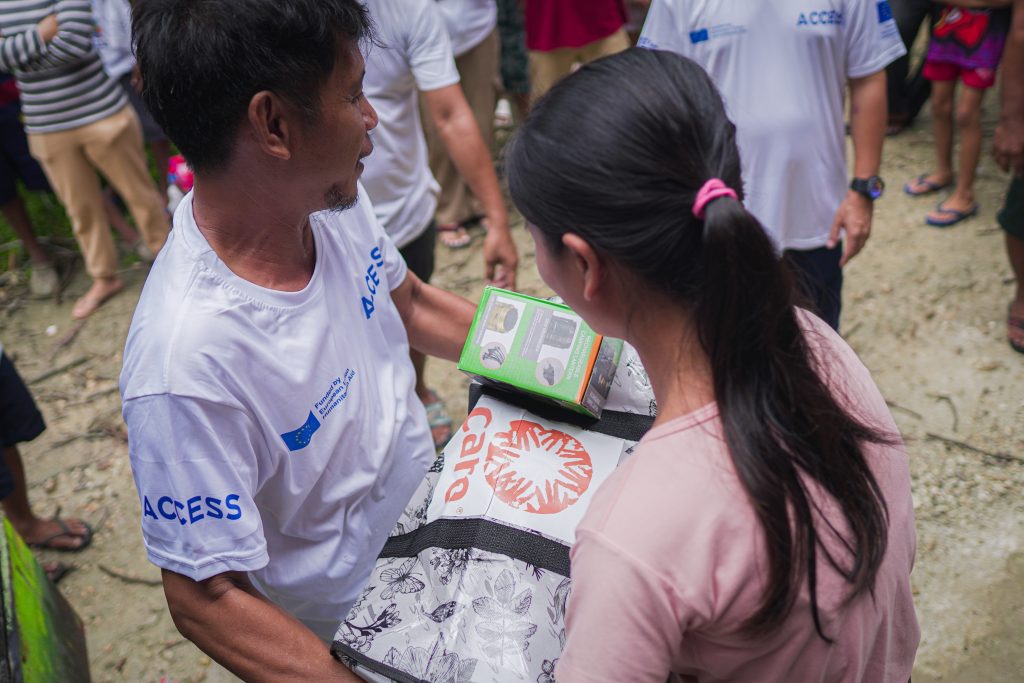
Photo: CARE staff hands a shelter Non-Food Item (NFI) kit and a solar lamp to a community member in Medellin, Cebu on October 30, as part of its Cebu Earthquake Emergency Response.

Dejito also emphasized that CARE is closely monitoring the situation in areas still recovering from previous disasters, such as northern Cebu which was hit by a magnitude 6.9 earthquake on September 30 and now lies in the typhoon’s projected path. “Our teams are coordinating with local partners to assess risks, communicate early warnings, and prepare for potential compound impacts,” she said. 

“We know that those already coping with disaster impacts—especially women, girls, and people with disabilities—face heightened risks when storms hit. That’s why we take early action, reinforce local capacities, and focus on delivering timely, targeted support before the worst conditions arrive.” 

For media inquiries, please contact: 

Mary Therese L. Norbe

Communications Specialist

marytherese.norbe@care.org

Notes to the editor: 

  • CARE’s initial response priorities include food, clean water, shelter support, and hygiene kits. 
  • This mobilization for Typhoon Tino comes as CARE Philippines continues its response to other recent disasters, including Tropical Cyclone Opong, and the earthquakes in Cebu and Davao.
  • CARE Philippines has a long history of responding to typhoons, including Super Typhoon Haiyan (Yolanda) in 2013, Super Typhoon Rai (Odette) in 2021 and Super Typhoon Nando (2025).  

An end to the nightly vigil against the rain

For Ronie and Zeny, the sound of water was the sound of home. For ten years, their house in the village of Dilam stood meters from the shore, and the rhythm of the waves was a constant presence. However, after Super Typhoon Nando swept their life away, the sound of rain became a source of nightly dread.

Their home was gone, replaced by a ruin of wood and debris. Refusing to surrender, they salvaged what they could to build a shelter for their two sons. They gathered scraps of wood and assembled a frame and walls. But they faced a challenge: the cogon grass used for roofing had been destroyed by the typhoon. Their new roof was only half-complete, a shield that could not protect them.

The nightly vigil began. When the frequent rains fell, the family would huddle in the one dry corner of the shelter. They would sit in the damp darkness and wait for the downpour to stop so they could sleep again.

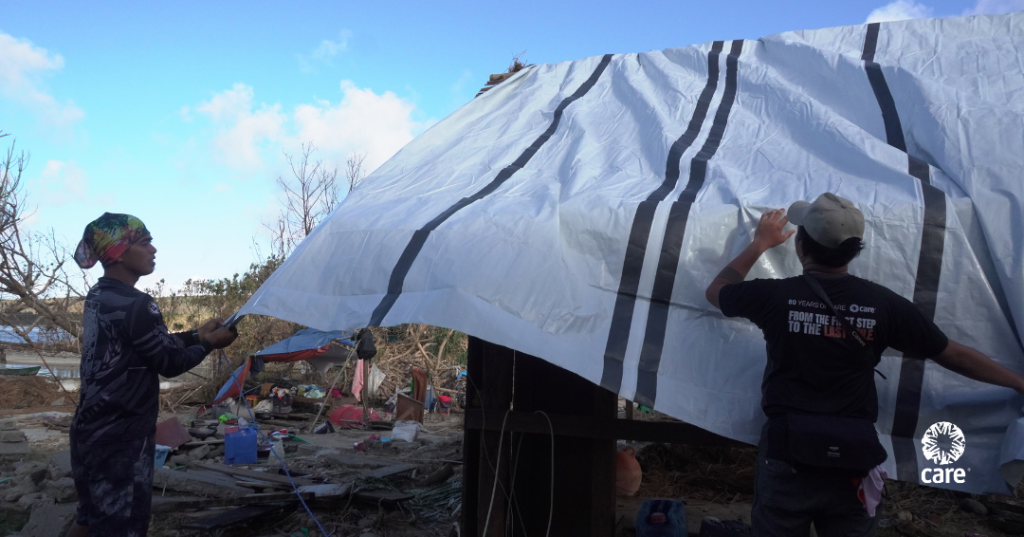
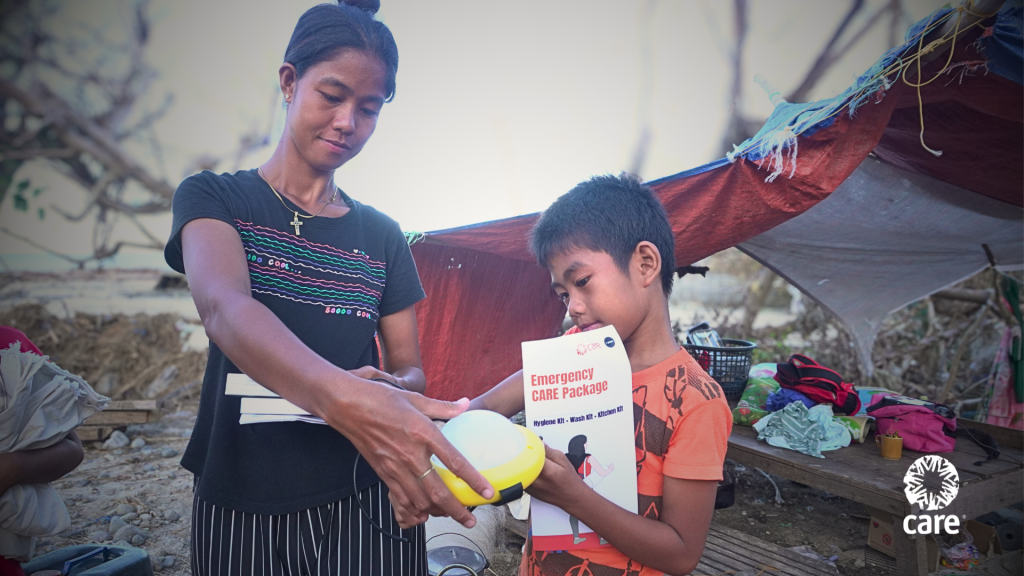
Relief arrived in the form of the Emergency CARE Package (ECP). The 22-kilogram package contained 39 essential items, but for the couple, one stood out: a wide, fire-retardant tarpaulin sheet. It was the answer to their problem.

They worked to stretch the sheet over the gap in their roof and secure it against the wind. That night, as rain began to fall, the sound was different. It was the patter on a secure roof. For the first time since the typhoon, the family did not have to move. They remained on their mats, warm and dry. Their nightly vigil against the rain was over.

“We were worried that if our roof was not completed, our children would get sick, especially, our eldest who is already ill”, Ronie shared.

With their fear conquered, they could look to the future. The tarpaulin provided a crucial, temporary fix; using cash assistance from the government, they now plan to buy galvanized iron (GI) sheets to build a more permanent roof. The vigil had ended, allowing them to shift their focus from surviving the night to rebuilding their days.

The ECP also provided a solar lamp, a cooking stove, and hygiene items. Zeny knew the lamp was vital. “It means our children can still sit down and study their lessons at night,” she said. The vigil had ended, allowing the family to move from surviving the night to rebuilding their days.

Ronie and Zeny’s family was one of 250 households to receive this support. CARE provided the Emergency CARE Packages to Dilam, one of the most affected communities on the island. These items help families reinforce their living spaces and meet their immediate needs, restoring a sense of safety and dignity.

CARE’s work in the wider municipality of Calayan demonstrates a commitment to stand with the hardest-to-reach communities as they begin to rebuild. As we scale up our emergency response to assist multiple communities in crisis, Emergency CARE Packages were also provided to another 250 families in last-mile communities in Cebu affected by the recent 6.9 magnitude earthquake.

Volunteers Bring Psychological First Aid to Earthquake Survivors

  • Tanya Mariano
  • Blog, Disaster Response, Featured Stories, Latest News & Stories

In the aftermath of disasters, one of the biggest impacts is often invisible: trauma.

Following the magnitude 6.9 earthquake that hit Cebu, Philippines late in the evening of September 30, 2025, life has moved primarily outdoors for fear that aftershocks would topple homes and buildings.

Days later, residents affected by the destructive tremor – one group huddled under a tent, another by the roadside – gathered to tell stories. A child talked about losing a best friend, and the many plans they still had together. “I hope this is over soon,” said another, referring to the aftershocks, now numbering over 10,000. Witnessing the death of neighbors up close, some cried, others laughed nervously, perhaps as a way to cope.

Among those listening to them is Betcheba Ellorico Prochina, an educator by profession, and one of several volunteers – teachers, a social worker, and psychiatrists – who made the journey to Bogo City, Cebu from Agusan del Sur in northeastern Mindanao to provide psychological first aid (PFA) to communities affected by the quake.

A teacher’s calling: traveling miles to bring care, expecting no reward

Betcheba and the rest of the volunteers were trained in PFA in 2023 by an EU Humanitarian Aid-funded project called REACH, implemented by ACCORD, CARE, and partners.

That same year, they put their training into action when a 6.8 magnitude earthquake hit Sarangani in November 2023. ACCESS, another EU-funded action also led by ACCORD, CARE, and partners, sent out a call for volunteers to provide PFA to affected families.

The trip from Agusan del Sur to Sarangani was long – more than eight hours by land – and the task was emotionally demanding, but Betcheba had no second thoughts: “Volunteering is good for the heart,” she says. “We’re not psychologists, but through our simple way of delivering PFA, we were able to ease their psychological burden.”

In Cebu, trapped in traffic gridlock for hours, one song kept playing in her head: “Yes, I’m a teacher; I must brave all the roaring waves and the fury of the river and windy seas; I must climb on up the mountains and hills where children there wait for my love and care.”

What is psychological first aid?

“Before, people focused only on first aid for physical wounds and often neglected one of the most important aspects of our lives: our psychological and emotional well-being,” Betcheba explains. “Like a physical wound, if left unattended, it can worsen. For people who have experienced trauma, PFA helps them bounce back and regain a positive outlook.”

The sessions are designed to help participants process their experiences and emotions. Volunteers use games, songs, and simple activity sheets to help participants recognize and express their feelings. With gentle encouragement and non-judgmental listening, conversations begin to flow, and the weight of trauma can start to lift. Participants also learn practical tools such as breathing exercises to manage stress.

The volunteers knew their visit was only the first step, and that ongoing support would be crucial, especially for children and older persons, whose trauma might manifest in subtler ways.

Says Betcheba, “Volunteering is one way of destressing myself by destressing others. I’m glad that, if only for a short while, we helped take their minds off their worries.”

Local capacity building promotes fast, sustainable emergency response

Betcheba and the volunteers’ story is testament to the lasting impact of empowering local actors. Trained under a previous project, they consistently step up to serve other communities during new emergencies, a clear ripple of positive change extending well beyond the project’s timeline.


ACCESS is a multi-year, multi-sectoral project funded by the European Union Humanitarian Aid and implemented by a consortium of 14 local and international organizations: ACCORD, Action Against Hunger Philippines, CARE Philippines, Community Organizers Multiversity (COM), Humanity & Inclusion Philippines, Integrated Mindanaons Association for Natives (IMAN), Kadtabanga Foundation for Peace and Development Advocates, Mindanao Organization for Social and Economic Progress (MOSEP), Oxfam Pilipinas, People’s Disaster Risk Reduction Network (PDRRN), Plan International Pilipinas, Save the Children Philippines, United Youth for Peace and Development (UNYPAD), and United Youth of the Philippines – Women (UnYPhil-Women).

Magnitude 7.4 earthquake strikes Davao Oriental, Philippines; CARE and partners stand ready to respond 

  • Tanya Mariano
  • Latest News & Stories, Press Release

Manila, Philippines, October 11, 2025 – A powerful earthquake struck off the coast of Davao Oriental, Mindanao, in southern Philippines at 9:43 AM (PST) on October 10, 2025. Authorities issued a tsunami warning and urged precautionary coastal evacuations; the warning was later lifted after minor sea-level changes were recorded. Today’s quake comes just over a week after a destructive tremor near Cebu, a major island in the central Visayas region, and follows two powerful tropical cyclones, Nando (international name: Ragasa) and Opong (Bualoi), which battered parts of the country. These events underscore how frequently hazards strike the country and how quickly communities must pivot from one emergency to the next. 

“When disasters strike in rapid succession, it is always the most vulnerable who struggle to recover—and too often, that means women and girls. Our focus is listening to communities, responding to what they say they need, and standing behind local responders—especially women leaders—who are already protecting and rebuilding lives in last-mile areas. This is how we ensure that humanitarian aid doesn’t just arrive, but reaches those who need it most, safely and with dignity.” — Reiza S. Dejito, Country Director, CARE Philippines. 

According to initial updates from partners, shaking was felt widely across Mindanao. In Tagum City, lights and electric fans reportedly fell at a university as students evacuated. In Maragusan, residents described the ground as “jumping.” Kidapawan City experienced a temporary power interruption. In Tarragona, cracks were observed in some structures, and several coastal villages began evacuations after the tsunami warning. 

With partners in the EU Humanitarian Aid-funded ACCESS Project led by CARE, as well as the Humanitarian Partnership Platform, CARE Philippines is launching needs assessments in hard-hit and hard-to-reach areas, coordinating with local authorities to prioritize the efficient delivery of lifesaving assistance. Prepositioned supplies are being mobilized and response plans are underway. 

“Our teams and partners are launching coordinated assessments, working with local disaster risk reduction authorities and community organizations in the most affected areas. We will check damage to water points, shelters, and livelihoods. With aftershocks expected, we are prioritizing protection, clear information, and coordination so aid reaches those most in need as quickly and as safely as possible.” — Jessan Catre, Humanitarian, Disaster Resilience, and Peacebuilding Coordinator, CARE Philippines. 

The Philippine Institute of Volcanology and Seismology (PHIVOLCS) placed the epicenter offshore Davao Oriental and reported strong shaking across Davao Region and neighboring provinces. A tsunami warning was issued for several coastal provinces and later cancelled after a small sea-level change (~30 cm) was detected at Tandag, Surigao del Sur.  

Note to Editors:  

CARE has provided humanitarian and development support in the Philippines since 1949. As one of the most disaster-prone countries globally, the Philippines faces significant challenges, and CARE remains at the forefront of delivering life-saving support to communities most in need. According to the World Risk Index report, the Philippines has been ranked as the country most at risk for disasters for four consecutive years. This context underscores the critical importance of CARE’s work in humanitarian action, disaster preparedness, and strengthening local capacity.  


Media contacts:  

Mary Therese L. Norbe 

Communications Specialist, CARE Philippines 

marytherese.norbe@care.org | +639199117534 

Tanya Mariano 

Communications Specialist, CARE Philippines 

tanya.mariano@care.org | +639178514881 

ACCESS: Renewed Commitment to Timely, Dignified Humanitarian Aid

  • Tanya Mariano
  • Blog, Disaster Response, Latest News & Stories, Press Release

The European Union Humanitarian Aid-funded ACCESS Project is scaling up its humanitarian work in the Philippines through a two-year continuation, building on the lessons and gains from the past two years of delivering lifesaving assistance to families affected by conflict, displacement, and natural or climate-related hazards when they need it most. 

Reaching underserved, last-mile communities across the Philippines 

Since its launch in 2023, ACCESS has reached over 200,000 people with humanitarian aid and disaster preparedness support. This work will continue with ACCESS 2, which aims to reach 350,000 more people by 2027, still prioritizing the most at-risk individuals, including children, older persons, persons with disabilities, Indigenous Peoples, and newly displaced families in Mindanao and other crisis-affected areas. 

Speed, Accuracy, and Quality

ACCESS remains committed to speed, accuracy, and quality in humanitarian response. This means acting quickly once it is safe to do so, ensuring aid is well-targeted and relevant to needs, and upholding high technical standards. The project operates across sectors including food security, health, shelter, WASH, protection, education in emergencies, disaster preparedness, anticipatory action, and humanitarian coordination. A rapid response mechanism allows teams to mobilize within 24 to 72 hours once it is safe to reach affected communities. Whether addressing sudden emergencies or chronic crises, the project is guided by the principle that no one should be left behind, especially in hard-to-reach areas. 

“ACCESS delivers immediate humanitarian assistance to families affected and displaced by disasters and crises. With the support of the European Union, this effort ensures that aid reaches the most vulnerable, especially when local resources are not sufficient and needs are greatest.”

– Arlynn Aquino, Programme Officer and Head of Philippine Antenna, European Civil Protection and Humanitarian Aid Operations (ECHO)

Locally Led, Inclusive, Environmentally Responsible

ACCESS 2 brings together 14 international and local humanitarian organizations, many based in Mindanao. This locally led model draws on deep community knowledge and trusted relationships to deliver faster, more relevant assistance. Activities are gender- and age-sensitive and disability-inclusive, ensuring everyone’s needs are considered and assistance is provided without discrimination. The project also integrates environmental safeguards, following ECHO’s Minimum Environmental Requirements and climate-smart practices to reduce the impact of humanitarian activities.  

“ACCESS is about working together—side by side with national and local organizations, government units, and other humanitarian actors—to make sure help gets to the people who need it most. Our partners on the ground know the realities and the needs of their communities. By combining our strengths, we can respond faster, reach farther, and support communities not just to recover, but to be ready for future crises.”

– Reiza Dejito, Country Director of ACCESS consortium lead CARE Philippines

Coordination and Advocacy 

Beyond emergency response, ACCESS 2 invests in disaster preparedness at both community and subnational levels, helping local actors anticipate and mitigate risks. The project also includes a national advocacy component, working to strengthen policies and systems that protect at-risk populations.  To ensure resources are used effectively, ACCESS 2 provides humanitarian coordination support, aligning assistance with other partners and local authorities. 

Bridging Relief, Recovery, and Peace 

ACCESS embraces a humanitarian-development-peace nexus approach, linking immediate relief with long-term resilience and conflict sensitivity. This integrated strategy helps address urgent needs while supporting local systems and reducing the risks that drive recurring crises. 

Looking Ahead Together 

At its core, the new two-year continuation of ACCESS reflects a renewed commitment to communities facing the greatest challenges: those living through conflict, displacement, and natural and climate-related hazards. It builds on what has already been achieved, with a focus on delivering timely, inclusive, and principled humanitarian aid, and sustaining efforts to help people recover with dignity and prepare for future crises. By working together, we move closer to a future where communities are safer, stronger, and more resilient. 


About ACCESS 

ACCESS is multi-year, multi-sectoral humanitarian and disaster preparedness initiative funded by European Union Humanitarian Aid. It serves the most affected, underserved, difficult-to-reach communities in the Philippines, where natural hazards, conflict, recurrent displacement, and intensifying climate-related risks continue to threaten lives and livelihoods. 

ACCESS 2 is implemented by a consortium of 14 local and international organizations: ACCORD, Action Against Hunger Philippines, CARE Philippines, Community Organizers Multiversity (COM), Humanity & Inclusion Philippines, Integrated Mindanaons Association for Natives (IMAN), Kadtabanga Foundation for Peace and Development Advocates, Mindanao Organization for Social and Economic Progress (MOSEP), Oxfam Pilipinas, People’s Disaster Risk Reduction Network (PDRRN), Plan International Pilipinas, Save the Children Philippines, United Youth for Peace and Development (UNYPAD), and United Youth of the Philippines – Women (UnYPhil-Women).