The WE EMPOWER project aims to improve women’s economic empowerment and social well-being of abaca and rootcrops value chain actors (producers, processors, traders, and workers), particularly that of women and female youth.
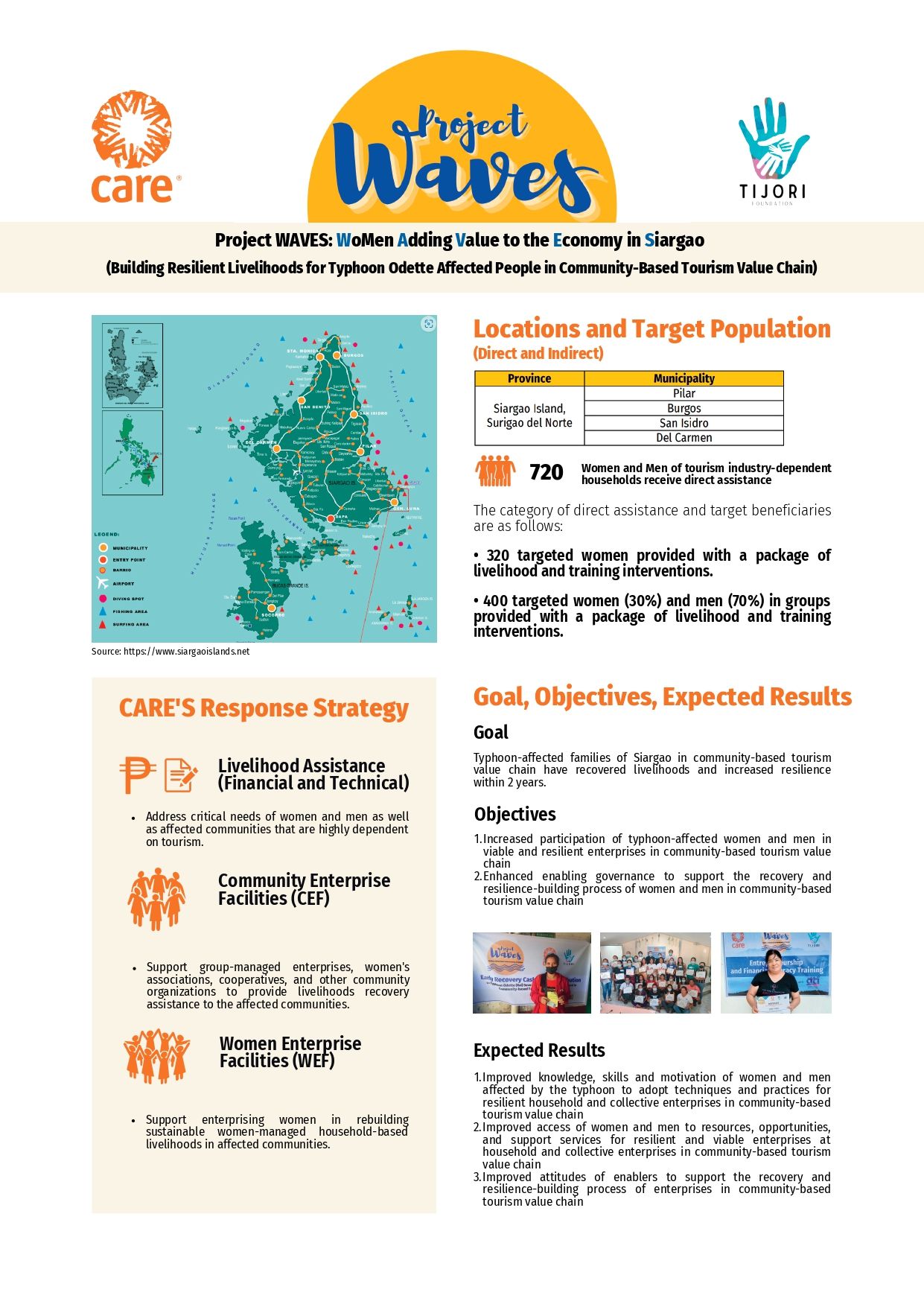
The project, WoMen Adding Value to the Economy in Siargao: Building Resilient Livelihoods for Typhoon Odette Affected People in Community-Based Tourism Value Chain aims to assist typhoon-affected families of Siargao in community-based tourism value chain recover their livelihoods and increase their resilience within 2 years.
Blog, Disaster Response, Featured Stories, Press Release
CARE Philippines Emergency Coordinator, Jerome Lanit hands over food items to a woman head of a household that was affected by the armed clashes in Ungkaya Pukan town in Basilan. (J. Dulla/CARE Philippines)
Five hundred eighty (580) households that were affected by the series of armed clashes in Brgy. Ulitan, Ungkaya Pukan, Basilan received essential food, non-food items, and shelter kits on February 4 and 5.
Members of these households were forced to leave their homes when combatants of the Moro Islamic Liberation Front (MILF) and the Philippine military clashed in November last year. When the conflict subsided, they returned only to find that some of their houses, including the mosque, madrasah, and an essential government building, were damaged from the fighting.
Some of the members of 120 households whose houses were damaged due to the fighting received shelter repair kits. (J. Dulla/CARE Philippines)
CARE and its partner, NISA Ul Haqq fi Bangsamoro, Inc., with the facilitation of the GPH-MILF Coordinating Committee on the Cessation of Hostilities (CCCH) and the Ad Hoc Joint Action Group (AHJAG) and with the support of the BARMM Ministry of Social Services and Development were able to access the community to deliver life-saving assistance to the affected vulnerable households.
“As humanitarians, it is important that we address first the needs of the members of vulnerable communities who still feel insecure because of the uncertainty of the situation while the peace mechanisms are working for a sustained solution to the conflict,” said Jerome Lanit, CARE’s Emergency Coordinator.
Meanwhile, Shalom Tillah Allian of NISA Ul Haqq fi Bangsamoro, Inc. shared that the collaboration with the BARMM MSSD, MILF CCCH and AHJAG showed that humanitarian and peace building efforts work meaningfully when working together on an equal footing.
“More than just the goods shared to them, to us what is more powerful is to see the mujahideens and the mujahidat owning the initiative as they led the distribution. We cannot overemphasize the importance of cultivating solidarity with the peace process mechanisms afforded to us”, she added.
Photos: Members of the community helped in the repacking and distribution of the relief goods to the affected households. (J. Dulla, S. Allian)
The Basilan Emergency Response is supported by the Tijori Foundation and is being implemented by CARE Philippines and its partner, NISA Ul Haqq fi Bangsamoro, Inc., in collaboration with the BARMM Ministry of Social Services and Development, GPH-MILF Coordinating Committee on the Cessation of Hostilities (CCCH) and the Ad Hoc Joint Action Group (AHJAG).
Blog, Featured Stories, Latest News & Stories, Stories of Change
It was nearly noon, and the sun was already scorching hot when Analyn, 48, picked string beans and snap peas on their 1.5-hectare vegetable farm up a hill in Brgy. Malabanan, Balete, Batangas. It was a grueling task because the trellises that held the vines up were bent low by the strong winds and rain brought by Typhoon Paeng (Nalgae) in September. She crouched to get the mature beans while dragging a sack where she put her harvest. Her husband, Pablo, 54, picked okra on the other side of the farm. They then met where two large wicker baskets were nearly filled with the vegetables they gathered. They began sorting those of market quality from those they would cook at home or sell to their neighbors downhill.
While packing the vegetables they would sell to the traders in the market, Analyn shared that they are reaping the results of their good decisions at the start of the cropping season.
They were one of several small farmers affected by the volcanic ash eruption of Mount Taal that were invited as participants to CARE’s aGAP (Asenso sa Good Agriculture Package). It was a project implemented with the Southern Tagalog People’s Response Center – STPRC, Inc. with support from the Metrobank Foundation, Inc. that assists marginalized farming households whose livelihoods have been doubly affected by the COVID-19 pandemic and the intermittent Taal Volcano eruptions since January 2020. One of the project’s supports was providing additional farming inputs such as training on good agriculture practices to the participants to help them improve their resiliency to the constant volcanic ash and other climate change effects on their farming.
They learned from one of the sustainable agriculture training they attended that they could plant madre de cacao, a nitrogen-fixing tree, as natural trellises for their climbing vegetables. Their usual wooden post trellis cost 15 pesos each (27 cents). They needed at least 500 post trellises. Using the madre de cacao meant they saved 7,500 pesos (135 dollars). And because it is planted and growing, the tree can help prevent the soil from eroding, and its nitrogen-rich leaves can be used as fertilizer. With the trees rooted to the ground, they withstood being felled by the typhoon’s winds. Hence, the family was able to keep harvesting from their farm.
Moreover, Pablo learned to make fermented plant juice (FPJ) which ingredients were mainly from the plants they were growing. This is an inexpensive alternative to chemical fertilizers. They usually spend 4,000 pesos (72) dollars for fertilizer. With the FPJ, they partially cut the cost for this.
Pablo stirs the fermented plant juice (FPJ) that he made at home using molasses and vegetables harvested from the family farm. | Photo: M. Norbe
“We still couldn’t entirely turn it into an organic farm because we needed the yield that the chemical fertilizers bring. But slowly, we are noticing how the natural fertilizers I made produce healthier plants”, Pablo shared.
He had already experimented using only the FPJ and animal manure on a plot of okra, producing market-quality fruits. He planned to continue applying the knowledge from the training to the farm and see how they could improve their yield.
Pablo harvests okra from a vegetable plot where he experimented full application of fermented fruit juice (FPJ). | Photo: M. Norbe
The FPJ applied produced good market-quality okra fruits with minimal cost compared to chemical fertilizers. | Photo: M. Norbe
For farmers like Pablo and Analyn, yield is the most critical factor in bringing sufficient income from farming. However, their harsh experiences with the changing climate and the constant exposure to volcanic ash taught them that if they didn’t change their ways of farming, their land would continuously be stripped of its fertility and eventually lose yield.
They have been farming for the past 20 years using chemical fertilizers. They observed how these turned the soil so acidic that for every cropping, they added more to produce the same yield as the last. The soil gets easily eroded too, when heavy rains pour. So, the couple are working hard to bring back their farm soil’s fertility and increase its resilience to extreme weather events by integrating good agricultural practices in their farming.
“We are getting older and we wanted to prepare this land for our son to inherit. When that day comes, this farm will be a thriving business that we hope for him to continue”, Analyn shared.
Featured Stories, Food & Nutrition, Latest News & Stories
Riza, 35, shows the vegetable seedlings that she and members of their group propagate in their nursery in Barangay Mahayahay, San Jose, Dinagat Island Province. Meanwhile, her 73-year-old mother, Matilde waters the plants in their communal garden where okra, string beans, peppers, squash, sweet potato, water spinach, and other vegetables are growing.
“We already harvested three times since we started the garden. It really helps especially at times when we don’t have enough money to buy food”, Riza shared.
She also said that they are growing their food using organic compost and fertilizers such as fermented fruit and plant juice which materials are sourced in their community.
Their members were trained in sustainable organic farming after Typhoon Rai (Odette) ruined their crops and stripped the garden soil barren.
Through the Immediate and Comprehensive Response for Communities Affected by Typhoon Rai (Odette), men and women members of their communities were organized and formed into mutual groups for reviving the former and engaging in alternative livelihoods.
Aside from their association’s dry goods stores, they decided to put up communal nurseries and gardens to ensure that food will always be on their table.
“After the typhoon, it was very difficult to find food. Now, when we harvest beans, we can store them both for seeds and food”, she added.
Blog, Featured Stories, Food & Nutrition, Latest News & Stories, Press Release, Women and Girls, Women and Girls
An analysis by humanitarian organization CARE highlights, for the first time, a global link between inequality experienced by women and girls and food insecurity. Analysing data from 2021, the report shows that across 109 countries, as inequality goes up, food security goes down.
Christine Campeau, CARE’s Global Advocacy Director – Food Systems, said, “Between 2018 and 2021, the number of hungry women versus hungry men grew 8.4 times, with a staggering 150 million more women than men hungry in 2021. And the implications of the escalation of conflict in Ukraine will make the situation even worse for women, who play a crucial role across food systems and in feeding their families and communities. Inequality based on sex is highly connected to food and nutrition security at a local, national, and global level. To put it simply, the more inequality faced by women and girls there is in a country, the hungrier and more malnourished people are.”
Of the four major global datasets, the only sex disaggregated food indicators reinforce women’s role solely for their importance in reproduction: measuring anemia in women of childbearing age and counting stunting for children. Most food security datasets remain conspicuously silent on sex-based disparities. And, despite a significant portion of food preparation and purchasing being managed by individuals responsible for household nourishment, those individuals are often the last to eat and receive the least food.
Even when both men and women are technically food insecure, women often bear bigger burdens. For example, in Somalia, while men report eating smaller meals, women report skipping meals altogether.
Aisha, who lives in a village in eastern Somalia said, “I don’t remember how old I really am, the drought has affected me mentally and physically so much that I can’t remember. Most days we don’t get anything to eat, other days we eat one meal.”
In the World Bank portal focused on food and women, the only sex disaggregated food data is related to the number of women who believe, or do not believe, that a husband is justified in beating his wife when she burns the food.
Ms Campeau underscored the need to recognize the central role of women in sustaining global food systems, stating that “as women keep feeding the world,” it is critical to ensure data systems allow for their realities to be seen and addressed. She called for improvements in data collection methods to make “the gaps they encounter visible” and stressed that “global datasets should be publishing sex disaggregated data on food.” To advance this effort, she emphasized the urgency to “update our global understanding of food security and the inequality lived by women and girls” and advocated for directing “flexible funding and support” to local organizations in crisis-affected areas to help mitigate risks of hunger-related violence and protection threats.
About CARE: Founded in 1945, CARE is a leading humanitarian organisation fighting global poverty. CARE has more than seven decades of experience helping people prepare for disasters, providing lifesaving assistance when a crisis hits, and helping communities recover after the emergency has passed. CARE places special focus on women and children, who are often disproportionately affected by disasters. To learn more, visit www.care-international.org
For media enquiries contact:
Suzy Sainovski Senior Humanitarian Communications Coordinator, CARE International Email: suzy.sainovski@care.org Skype: suzy.sainovski
Collaborating with 30 barangay local units to create vaccine awareness for ~260,000 people
Manila, Philippines (January 19, 2022)— Cargill and CARE Philippines, have collaborated with non-government organizations and business partners, to boost the vaccination rates in select areas of Bulacan Province, Batangas and South Cotabato by the end of 2021 through the COVID-19 Risk Communication and Community Engagement (RCCE) and Vaccination Roll-Out project. This vaccine advocacy project is expected to reach about 260,000 people.
More than a year after the Philippines launched its efforts for mass vaccination against COVID-19, there is still much work to be done to achieve population protection. The National Task Force against COVID-19 released statistics showcasing a slowed down rate of administering shots last October with only 375,773 compared to 523,018 of August 2021.
A possible reason could still be the existing hesitancies from Filipinos about vaccination, with only 61% of the population being willing to be vaccinated based from a survey released by the Octa Research group last October 22.
The Social Weather Stations conducted a survey to find out what the possible reasons are why Filipinos are unwilling despite being offered a free vaccination. The fear of possible side effects ranks as number one in the list followed by old age, being diagnosed with comorbidities and belief in reports of fatality.
“In Cargill, putting people first has always been a part of our values. And this value of caring for people goes beyond our employees and extends to those in the communities where we live and work. Through the RCCE and Vaccination Roll-Out Project, we aim to tip the scale in favor of population protection from COVID, thus allowing ourselves and our communities to bounce back from this pandemic,” said Christopher Ilagan, Cargill Philippines’ Corporate Affairs Director.
The RCCE and Vaccination Roll-Out Project, which is being implemented in Malolos City, Baliwag and Pulilan in Bulacan Province, Sto. Tomas City in Batangas, and General Santos City in South Cotabato, aims to support 30 barangay local government units (BLGUs) to increase their capacities in implementing COVID-19 policies and help encourage their residents to get vaccinated. More than 2,450 barangay officials, health workers and members of the peacekeeping team have already been trained by medical professionals to further spread information and provide communication about the risks of COVID-19 and vaccination benefits.
Support was also given to BLGUs with low vaccination rates by providing free transportation for vaccination to residents – especially women, PWDs and the elderly – from far-flung areas of the covered locations. Incentives were also given, like rice, food and hygiene kits, to encourage other community members to participate.
In alignment with the proclamation that 30 November – 01 December and 17-19 December 2021 as National Vaccination Days, the RCCE Project in Batangas and Bulacan provided free rides to 2,420 individuals from far flung barangays to the vaccination sites, free snacks and sanitary kits and distribution of information, education and campaign materials. The Community Health Educators (CHEs) hired and trained by the project also provided additional health manpower during the vaccination events at the selected barangays. Additionally, about 4,000 community members received rice and hygiene kits incentives from the project. Among these community members whom the project assisted to be vaccinated, more 700 of them confessed that previously, they are hesitant to take the shot but through the community education conducted by the project, they were encouraged to get vaccinated.
Romy M. Pagaduan, the chairperson of Brgy. Ligaya, General Santos City said that the project has made it easier for them to convince their residents to get vaccinated. He shared that his barangay is among those which have low vaccination rates due to people being less-informed, if not misinformed, about COVID-19 and the vaccines. “We now have the right answers to their questions especially those that were drawn from information they got from social media and rumors spread in the barangay”, he said.
The project is led by CARE Philippines and being implemented with Mindanao Coalition of Development NGO Networks (MINCODE) and Sarangani Province Empowerment for Community Transformation Forum (Spectrum) in General Santos City, Southern Tagalog People’s Resource Center (STPRC) in Batangas and CARE Philippines in Bulacan with participation from Cargill employees across all these areas.
This study is an exploratory action research on the controversial practice of female genital mutilation/cutting (FGM/C) in the Philippines in the predominantly Muslim, Bangsamoro Autonomous Region in Mindanao. Despite limited research on the practice and a lack of awareness among international and national stakeholders on the occurence of FGM in the Philippines, the study confirmed that the practice is still widespread in Bangsamoro. Alternative, non-harmful practices are gradually replacing FGM in a few areas, as driven by local leadershi
The 2020 Alternative Temporary Shelter (ATS) Manual is an initiative of the Moving Urban Poor Communities in the Philippines toward Resilience (MOVE UP) Project. This manual is intended for new and experienced users with zero to advanced ATS System and shelter response knowledge. This manual aims to describe the importance and practical applications of ATS and offer step-by-step guidance on properly adopting and implementing select ATS solutions as a form of shelter response and early action during emergencies. This manual provides guidance to local government units, civil society organizations, community members, and other stakeholders on addressing the immediate shelter needs of internally displaced populations (IDPs) within a 24- hour to 36-hour period after a disaster and even for long-term displacements while conforming with universally accepted humanitarian principles and standards. This manual is a working document and shall be updated from time to time.