Cherry prepares the ingredients for her barbeque marinade. To make ends meet, she sells grilled meats each afternoon in her neighborhood of Barangay Poblacion, Araceli, Palawan.
Story and Photos by Shirin Bandari
Cherry Cuberos, 50, is a leader of a livelihood group for women in Purok 2, Barangay Poblacion, Araceli, Dumaran Island, Palawan. The remote village suffered immensely when Typhoon Odette (Rai) devastated homes, roads, and public infrastructures in December 2021. Close to a year after the storm, the European Union Humanitarian Aid together with ACCORD Philippines provided crucial support through shelter repair, and cash assistance, and intervened in a project designed to engage and encourage participation and leadership among women.
Cherry is a working mother of four. She takes on multiple jobs to be able to feed her family. Her town suffered immensely when Typhoon Odette (Rai) made landfall in December 2021.
The European Union Humanitarian Aid, CARE, and ACCORD provided cash assistance and livelihood programs to those affected by Typhoon Odette (Rai). Through this, the Women’s Association in Barangay Poblacion, Araceli set up a compact general store to provide for the needs of the community at affordable prices.
Women and girls who survive disasters face overwhelming risks and immediate consequences such as displacement, trauma, sexual violence and exploitation, health services disruption, and financial instability, which can lead to devastating short- and long-term effects.
Cherry works part-time at the General Store run by women. She assists in the inventory of stocks and balances the daily sales ledger. The island’s remote location makes it difficult for supplies to reach the area. The newly opened General Store comes as a welcome relief to the community.
“When Typhoon Odette came, it was hard to move on from what happened to my home and family. My livelihood and earnings were affected. But through the help of the European Union Humanitarian Aid and ACCORD, we are very thankful that our Women’s Association was able to set up a General Store that sells groceries at affordable prices.” Cherry adds. “This General Store is part of the livelihood program which has become an invaluable addition to the community, the women who work with us are able to get enough for their daily expenses. It also provides groceries on loan for women in our area who are struggling to feed or put their children through school.” Cherry Cuberos explains.
“Some women in our association are single mothers and are unable to support their families. At the same time, others make rice cakes or have opened small carinderias. We allow them to take goods on loan from the General Store, in case they are short on supplies. They repay us once the food is sold. This way we support other small businesses to grow and see a return on investment”
Through Cherry’s devotion to her women’s association and volunteerism, she is able to provide for her family and serve as an inspiration, by encouraging others to band together to rebuild what was lost and be contributing members of their community.
A mother with her infant visits the local barangay health center where Cherry has volunteered her time for the past 20 years.
Cherry meets with the Women’s Association at the Barangay Hall to discuss new ideas on ways to improve their livelihood. She encourages others to join them so more can benefit from the program “They just need to trust us to have a good relationship. We are here to help them and the community.”
Cherry monitors an infant’s temperature. She has proven to be a devoted member of the Araceli community.
Essential health services were abruptly put on hold when Typhoon Odette hit the shores of Araceli. Today, Cherry is able to assist the local nurses and doctors to tend to local patients.
Tuberculosis remains a pressing issue in the islands of Palawan. Cherry has been trained to test swab samples of patients so they may know their current health status.
“It is my dream that my children can finish their studies. I invite others to keep our barangay clean. I hope that I can continue to help the people in my community.”
Blog, Featured Stories, Latest News & Stories, Uncategorized
Written by Shirin Bandari
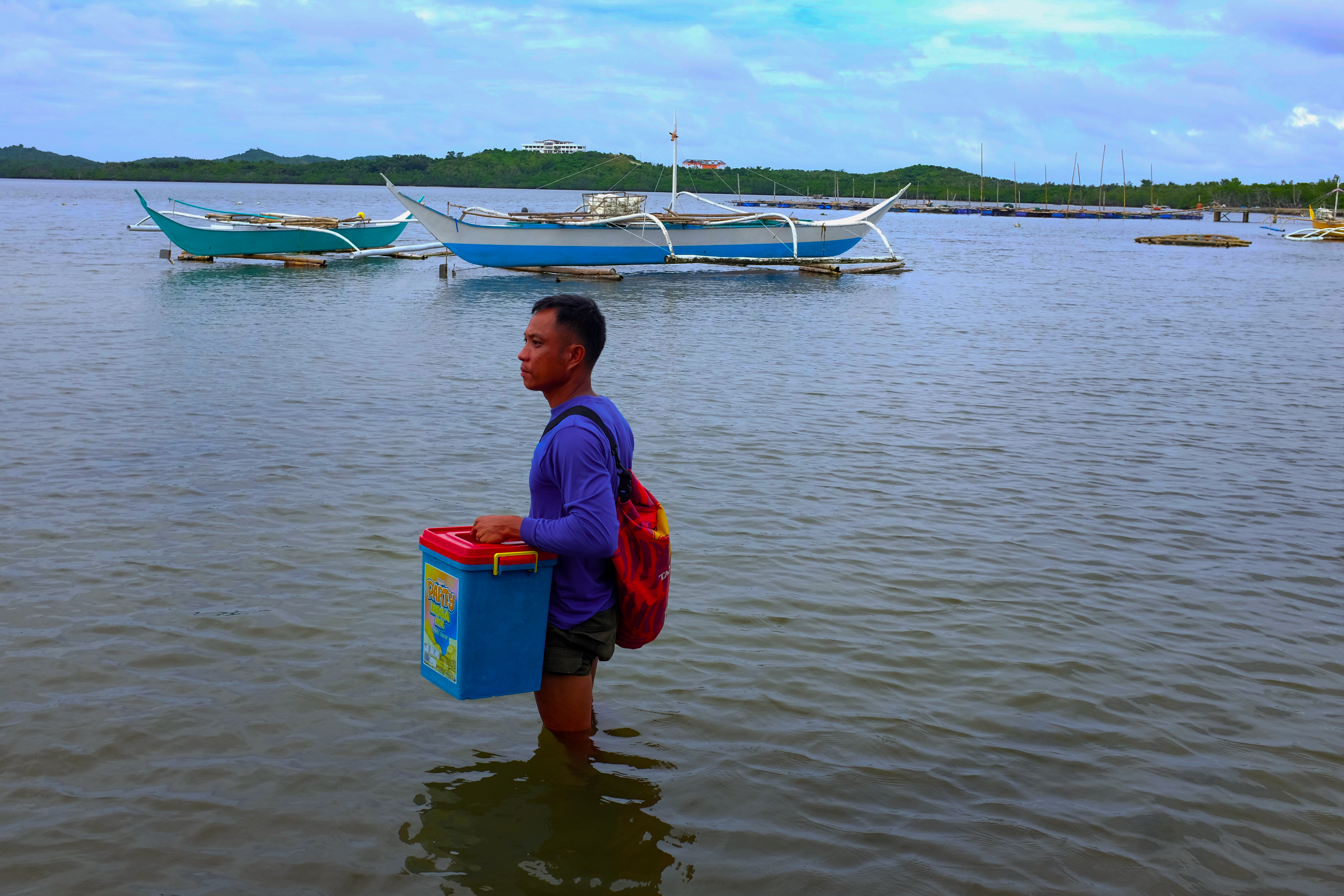
Rizaldo prepares his clothes for the boat ride ahead. A medium-sized plastic container is by his side as he sits crossed-legged on the floor. An array of papers and personal items are laid out before him as he decides what to pack for the journey. In rough waters, it sometimes takes him four hours to travel from his hometown of Araceli, Palawan to the isolated island of Kalandagan. The large waves make it harder for him to traverse the sea in his wooden boat. The island is only accessible by boat and becomes incommunicado during the monsoon season.
Left: A blue plastic container rests next to Rizaldo as he sits at home and organizes items that he will bring for his journey to Maducang Elementary School in Barangay Kalandagan. This prevents it from getting wet in the rough seas he must traverse to reach the island. | Shirin Bandari
Below: Rizaldo’s personal items that he packs on each trip to Kalandagan. | Shirin Bandari
Rizaldo Gandola has been a teacher for the past five years at Maducang Elementary School in Barangay Kalandagan.
“It can be risky. But even if it is hard, when I’m not on the island, I miss the children. I want to be with them every day,“ Rizaldo says.
His love for teaching and dedication to his students motivate him to push through the dangerous commute. He spends weekends with his family in Araceli and uses the time in town to file his reports because of the weak internet signal, and stocks up on food due to the limited supplies on the island. In his free time, he goes out to sea to fish for added income so he can afford the gasoline for his boat. But for the rest of the week after each class, Rizaldo lives alone in a quaint hut near the school. He has grown used to the routine and enjoys the tranquility around him.
The coastal towns of Palawan reaped the devastating effects of Typhoon Odette (Rai) which made landfall in December 2021. The super typhoon ravaged homes, roads, and public facilities including Rizaldo’s school in Maducang. “This is the first time it has happened, a typhoon so strong, it destroyed close to 80% of the homes.” All four classrooms in the elementary school were shattered, metal roofs ripped and crumpled like paper. Tables, computers, and books were ruined by the gale-force winds and rain.
Fishing, the main source of livelihood on the islands, was affected with boats wrecked, the island was cut off from essential aid and supplies until the weather improved so outside help could reach the locals.
Nearly a year after the devastating super typhoon, the people of Barangay Landagan are steadily rebuilding their lives through the support of the European Union Humanitarian Aid, CARE, ACCORD, and dedicated teachers like Rizaldo.
“At the time there was no evacuation area except for the school, but even that was impossible. The locals went to the top of a mountain instead to spend the night and take refuge,” Rizaldo says.
“Project leaders from ACCORD saw our situation and immediately provided hygiene kits, signal boosters so people could contact their loved ones, and invaluable solar panels that were our only source of light and energy,” Rizaldo adds.
Rizaldo stands in a classroom where he usually does the needed paperwork and other school-related documents whenever he goes home from the village of Kalandagan. | Shirin Bandari
The pandemic prevented face-to-face classes and for the past two years, Rizaldo’s students struggled to learn at home using modules. By the time classes resumed, only 70% could read efficiently. The devastation brought by Typhoon Odette (Rai) further amplified the situation and the children in the community were in dire need of help. CARE and ACCORD assisted in laying the groundwork to bring in volunteer teachers to focus on the children who needed more attention in learning how to read, write and count, easing the pressure on Rizaldo and the rest of the three teachers on the island.
“It has been a tremendous help to receive learning kits, training materials, and storybooks, which were crucial in improving the standard of education in Maducang, where children face limited opportunities,” Rizaldo says. “In the years I have been teaching on the island, families are too poor to buy new bags, shoes, and uniforms. “
In times of disaster — food, water, and shelter are urgent concerns, but as the community recovers, continued access to education is equally important.
Rizaldo is often asked by family and friends why he chooses to teach under such difficult circumstances. “The people of Maducang have been good to me, I do not want to leave the school because I have come to love the children”.
“It is my dream to help them finish their education. May they learn something from me, so they can have a chance to experience a better life.”
The Immediate and Comprehensive Response for Communities Affected by Typhoon Rai (Odette) is funded by the European Union Humanitarian Aid and jointly implemented by CARE Philippines, ACCORD Incorporated, Action Against Hunger Philippines, National Rural Women Coalition (PKKK), and Plan International in Dinagat Islands, Palawan, Southern Leyte, Bohol, Negros Occidental, and Cebu, in the Philippines.
How a change in circumstances forced fire survivors to rebuild their lives and build a supportive community in the process
The bustle of the transactions made at the Pagbangon Sari-sari (Rising Retail Shop) break the usual tranquil atmosphere at the Pamalihi transitory shelter site in Barangay Pagatpat, Cagayan de Oro City. Michelle Lagudas, 29, one of the storekeepers, carefully arranged the grocery items that were delivered by their supplier while her fellow storekeeper, Aida Ayunan, 29, tended to a customer buying firewood outside. They had been doing this thoroughly since their organization, the Pagbangon Community Savings Group (CSG) established the store on November 30, 2021. Pagbangon, in the local language, means to rise again after a downfall.
The group started with only 24,000 pesos (480 euros) of capital that the 20 members pooled in from the livelihood assistance they received in 2021 from the MOVE UP project. After a series of financial literacy and business management training, the group decided to put up the business, and eventually, develop into a thriving enterprise.
“It’s a tedious task, more so these past few months when the store has grown bigger and we have more customers to attend to”, Michelle shared.
Michelle with her daughter and Aida on storekeeping duty at the Pagbangon Sari Sari Store | Photo: Mary Therese Norbe/CARE
Most of the members were not new to enterprising. They had small businesses before a huge fire razed their village at Binunuan Creek, Brgy. Carmen on June 21, 2020. Michelle and her 47-year-old mother, Jeanylyn, managed a store near the creek and a stall at the Cogon market. The store’s bookkeeper, Jessica Lugsanay, 41, had a fruit stall at the Agora market and a flourishing side hustle as a hairstylist. The CSG’s President, Paul Michael Cinco, 43, had a successful business of making and consigning rice cakes and cassava rolls to malls, school cafeterias, and markets. All these were gone in an instant when their houses, properties, and valuables were consumed by the fire.
Paul Michael recalled how he attempted to carry the machine he uses to make cassava rolls as his neighbors clamor to get to safety. When he heard the cries for help, he left the machine and hurried to destroy the locked gate that was their only exit. The gate was locked because of COVID-19 restrictions at that time and the keykeeper couldn’t find the key due to panic.
“We had to kick the gate with all our strength because we could already feel the heat of the fire around us. We had to save ourselves and our families first”, Paul Michael shared about his experience.
Forty-nine (49) households in their community lost everything to the fire and were temporarily sheltered at the covered court of Carmen National High School. Many of them found that the first few days at the evacuation shelter were unbearable. All survivors had to share the same space and privacy became a huge concern, especially for women and girls.
The European Union Humanitarian Aid-funded Moving Urban Poor Communities towards Resilience (MOVE UP) had been working with the Barangay Carmen officials in developing an alternative temporary shelter (ATS) that fits the need and context of the highly-urbanized barangay. A total of 48 ATS units have been deployed to ensure that fire survivors are safe and protected, especially women, children, and the elderly. Women find it more comfortable to live in a space where their privacy is observed, albeit temporarily, and families were kept together.
On September 11, 2020, the school petitioned the city government for the relocation of the evacuees because of the opening of classes. The survivor families were brought to the Pamalihi transitory shelter site while their permanent relocation was being processed. They had to endure yet another difficult situation there as the site, which was still in its last phase of construction, didn’t have electricity and water supply. They relied on a spring for water (even if it is untested for safety) and lighting from candles. The site was about 30 minutes away from the city center, and the cost of travel caused additional burden for they had no source of income.
Through the project, 20 survivor families grouped together as the Pagbangon CSG, a year after their relocation, on September 11, 2022. True to its meaning, Pagbangon, the group is determined to rise from their situation and become more resilient using their shared knowledge, skills, and experience.
The Pagbangon Community Savings Group officers with their savings passbook and community savings box. | Photo: Mary Therese Norbe/CARE
Their social fund had already assisted four people when they needed money for hospitalization. Their store has grown so fast that it is estimated to bring in net sales of 80,000 pesos (1,600 euros) by the end of 2022. They were also able to donate for their community’s annual gathering from their store’s profit. They have saved a total of 50,000 pesos (849 euros) and opened a bank account where their profit amounting to 60,000 pesos (1,017 euros) was deposited. The officers didn’t have any experience in opening a bank account, so the CSWD social workers helped them in securing necessary documents to file and also assured the bank of the organization’s legitimacy.
The CSWD’s support has been instrumental in the ongoing recovery of the CSG members. The department has dedicated a staff to monitor and support the existing 14 CSGs organized through MOVE UP. This provides legitimacy to CSGs as they were registered as local civil society organizations supported by the City. Aside from resilient livelihood capacity development, parent effectiveness and other protection-oriented training were also provided to the CSGs. MOVE UP is also providing a camp coordination and camp management training for CSWD staff integrating ATS strategies to better ensure inclusion, protection, and anti-gender-based violence practices in their evacuation plans.
Farhana Acmad, 26, is one of the CSWD social workers whose focus is on organizing, developing and sustaining the 14 established CSGs in the city. She shared that it was a learning and motivating experience for her and colleagues to be more effective in their work.
“We had to change our perspective of support because the CSG model is not a charity. It is an empowering model where communities are taking charge and are mutually supporting each other in their recovery and development”, she shared.
This was true to how the Pagbangon CSG’s business has grown successfully because of the conscious efforts of its members to be a model of change in their community. Their business paved the way for them to support their members in times of emergencies. It also brought income not only to their group but also to neighboring indigenous communities who supply their store with firewood, bananas, coconuts, and vegetables. The same communities buy from their store some items that they need. Through this, they were able to make food and other necessities accessible to their community and to others.
The impact of the CSG model has also been felt at the household level, especially during times of need. Janice Cantiveros, 31, was about to give birth but their temporary housing unit didn’t have electricity. She requested a loan of 8,000 pesos (136 euros) to purchase a solar lamp, anticipating the difficulty of taking care of a newborn without lighting. It also made her feel safe and secure. Through this loan, her husband was also able to apply for a driving license and find work as a driver. They now have a source of income that has been more than helpful in raising their child.
“Our plan for next year is to put a part of our profits into the social fund so that we’ll be assured that in times of great need, our members will have money to use”, said a determined Jeanylyn, one of the Pagbangon CSG officers. With their grit and tenacity, the CSG members know they can make it happen.
After Typhoon Odette brought her family’s house down, Precious, her parents and siblings are now enjoying the warmth and comfort of their house that was built to resist natural hazards such as storms, typhoons, floods, and earthquakes.
Watch her story here:
Precious’ parents Barney and Eunice shared that in the past two months, their new house withstood the heavy rain and strong winds that the rainy season brought in. Their CGI roofing was nailed and braced securely and was able to hold out against the wind. Their marine plywood walls were also braced for the wind and its material protected them from the rain.
Since #TyphoonOdette flew their roof off and took their bamboo walls down, Eunice said that they have never felt safe and secure until they moved into their new house.
“It rained heavily last night but we were confident that we would be safe because of how sturdy our house is”, she added.
The family was sheltered in the latter’s mother’s house after the typhoon until CARE and National Rural Women Coalition (PKKK) came to their barangay to support affected families in their efforts to repair or rebuild their houses.
Through the Immediate and Comprehensive Response for Communities Affected by Typhoon Rai in the Philippines, they were able to access shelter repair kits. The barangay also recommended their family be assisted in repairing their house through mutual help or the bayanihan system. Volunteer carpenters and other members of the community helped in the repair.
This is usually done when some members of the community such as the elderly, the sick, and persons with disabilities are not able to repair or rebuild their houses on their own. Barney said that his epilepsy prevented him from doing the construction, hence, he was thankful that his community helped his family.
He and his wife are presently managing a small sari-sari store and internet vending business in their house. They will also be supported by the response through livelihood enhancement training and addition to capital.
Blog, Featured Stories, Latest News & Stories, Press Release
Humanitarian organizations will be launching a photo exhibit in Siargao next week to raise awareness about the impact of Typhoon Odette (international name: Rai) and the concerted efforts of residents and various groups in rebuilding the affected communities.
The photo exhibition dubbed “The Last Mile,” which will open on August 15, 6 p.m. at the Siago Beach Resort in General Luna, Siargao Island, just a few days before the commemoration of the World Humanitarian Day (August 19).
The event is organized by non-government organizations and local government units working on the Typhoon Odette Response. The aim of the event is to urge the national government and other stakeholders to not forget those most vulnerable in times of disaster.
It will feature almost a hundred images captured by organizations who implemented the European Civil Protection and Humanitarian Aid Operations (EU-ECHO)-supported emergency response for the survivors of Typhoon Odette: ACCORD, Action Against Hunger, Care Philippines, Humanity & Inclusion, Initiatives for Dialogue and Empowerment through Alternative Legal Services (IDEALS) Inc., National Rural Women’s Coalition, Oxfam Pilipinas, Plan International, Save the Children Philippines, and Sentro para sa Ikauunlad ng Katutubong Agham at Teknolohiya (SIKAT) Inc.
European Union (EU) Ambassador to the Philippines Luc Veron will be giving a message at the opening event of the exhibit, followed by presentations by the participating organizations.
“We want to showcase these powerful images to show just how devastating typhoons are to marginalized and remote communities in the Philippines. We also want to show what we can do together to save lives and reduce the risks and impacts of disasters,” said Oxfam Pilipinas Country Director Lot Felizco.
“With climate change, we expect more intense typhoons to hit the Philippines. We hope the exhibit will also give people hope that something can be done and is being done to strengthen our communities against future disasters and to help them recover from Typhoon Odette,” she added.
CARE Philippines Country Director David Gazashvili said the exhibit will also show the achievements and challenges that residents and humanitarian organizations face eight months after the devastation of Typhoon Odette.
“The exhibit shows how the quick and substantial funding from the EU-ECHO, the power of communities, women and men, boys and girls working together and collaborating with humanitarian actors have effectively addressed urgent humanitarian needs, especially of those who need the most assistance. But it also brings to the surface the challenges of prioritizing disaster-preparedness, risk reduction, and climate change mitigation and adaptation,” he added.
EU-ECHO’s funding of the Typhoon Odette emergency response has enabled the provision of emergency services to almost half a million individuals in Bohol, Cebu, Dinagat Islands, Southern Leyte, Negros Occidental, Palawan, and Surigao del Norte through the implementation of two consortia: one led by CARE, with ACCORD Inc., National Rural Women’s Coalition, Plan International, and Action Against Hunger; and another led by Oxfam Pilipinas and jointly implemented by Save the Children and Humanity & Inclusion (HI), together with local partners SIKAT Inc. and IDEALS Inc.
The joint efforts of the groups resulted in the distribution of food and livelihood assistance to 70,643 individuals; water, sanitation and hygiene packs for 75,394; protection assistance for 147,549; shelter provision for 72,902; health services for 68,317; and “education in emergency” assistance for 41,205.
Besides attending the photo exhibit, the EU ambassador will also be visiting Pilar in Siargao Island to observe EU-ECHO-funded activities such as the “Education in Emergency” component of the project in Caridad Elementary School. As part of the Typhoon Odette Emergency Response, the school’s teachers received training, supplies and a multi-purpose learning space where “return to learning” sessions are being held. The consortium also assisted in the construction of the multi-learning space and the repair of the damaged classrooms, which will also be turned over next week
For the coming months, the groups will continue to provide the same support for the most affected communities in Bohol, Cebu, Dinagat Islands, Southern Leyte, Negros Occidental, Palawan, and Surigao del Norte.
###
FOR MEDIA INQUIRIES AND COORDINATION:
Kristine Sabillo Guerrero | Senior Officer for Media and Digital Influencing, Oxfam Pilipinas
Blog, Featured Stories, Food & Nutrition, Latest News & Stories, Press Release, Women and Girls, Women and Girls
An analysis by humanitarian organization CARE highlights, for the first time, a global link between inequality experienced by women and girls and food insecurity. Analysing data from 2021, the report shows that across 109 countries, as inequality goes up, food security goes down.
Christine Campeau, CARE’s Global Advocacy Director – Food Systems, said, “Between 2018 and 2021, the number of hungry women versus hungry men grew 8.4 times, with a staggering 150 million more women than men hungry in 2021. And the implications of the escalation of conflict in Ukraine will make the situation even worse for women, who play a crucial role across food systems and in feeding their families and communities. Inequality based on sex is highly connected to food and nutrition security at a local, national, and global level. To put it simply, the more inequality faced by women and girls there is in a country, the hungrier and more malnourished people are.”
Of the four major global datasets, the only sex disaggregated food indicators reinforce women’s role solely for their importance in reproduction: measuring anemia in women of childbearing age and counting stunting for children. Most food security datasets remain conspicuously silent on sex-based disparities. And, despite a significant portion of food preparation and purchasing being managed by individuals responsible for household nourishment, those individuals are often the last to eat and receive the least food.
Even when both men and women are technically food insecure, women often bear bigger burdens. For example, in Somalia, while men report eating smaller meals, women report skipping meals altogether.
Aisha, who lives in a village in eastern Somalia said, “I don’t remember how old I really am, the drought has affected me mentally and physically so much that I can’t remember. Most days we don’t get anything to eat, other days we eat one meal.”
In the World Bank portal focused on food and women, the only sex disaggregated food data is related to the number of women who believe, or do not believe, that a husband is justified in beating his wife when she burns the food.
Ms Campeau underscored the need to recognize the central role of women in sustaining global food systems, stating that “as women keep feeding the world,” it is critical to ensure data systems allow for their realities to be seen and addressed. She called for improvements in data collection methods to make “the gaps they encounter visible” and stressed that “global datasets should be publishing sex disaggregated data on food.” To advance this effort, she emphasized the urgency to “update our global understanding of food security and the inequality lived by women and girls” and advocated for directing “flexible funding and support” to local organizations in crisis-affected areas to help mitigate risks of hunger-related violence and protection threats.
About CARE: Founded in 1945, CARE is a leading humanitarian organisation fighting global poverty. CARE has more than seven decades of experience helping people prepare for disasters, providing lifesaving assistance when a crisis hits, and helping communities recover after the emergency has passed. CARE places special focus on women and children, who are often disproportionately affected by disasters. To learn more, visit www.care-international.org
For media enquiries contact:
Suzy Sainovski Senior Humanitarian Communications Coordinator, CARE International Email: suzy.sainovski@care.org Skype: suzy.sainovski
Collaborating with 30 barangay local units to create vaccine awareness for ~260,000 people
Manila, Philippines (January 19, 2022)— Cargill and CARE Philippines, have collaborated with non-government organizations and business partners, to boost the vaccination rates in select areas of Bulacan Province, Batangas and South Cotabato by the end of 2021 through the COVID-19 Risk Communication and Community Engagement (RCCE) and Vaccination Roll-Out project. This vaccine advocacy project is expected to reach about 260,000 people.
More than a year after the Philippines launched its efforts for mass vaccination against COVID-19, there is still much work to be done to achieve population protection. The National Task Force against COVID-19 released statistics showcasing a slowed down rate of administering shots last October with only 375,773 compared to 523,018 of August 2021.
A possible reason could still be the existing hesitancies from Filipinos about vaccination, with only 61% of the population being willing to be vaccinated based from a survey released by the Octa Research group last October 22.
The Social Weather Stations conducted a survey to find out what the possible reasons are why Filipinos are unwilling despite being offered a free vaccination. The fear of possible side effects ranks as number one in the list followed by old age, being diagnosed with comorbidities and belief in reports of fatality.
“In Cargill, putting people first has always been a part of our values. And this value of caring for people goes beyond our employees and extends to those in the communities where we live and work. Through the RCCE and Vaccination Roll-Out Project, we aim to tip the scale in favor of population protection from COVID, thus allowing ourselves and our communities to bounce back from this pandemic,” said Christopher Ilagan, Cargill Philippines’ Corporate Affairs Director.
The RCCE and Vaccination Roll-Out Project, which is being implemented in Malolos City, Baliwag and Pulilan in Bulacan Province, Sto. Tomas City in Batangas, and General Santos City in South Cotabato, aims to support 30 barangay local government units (BLGUs) to increase their capacities in implementing COVID-19 policies and help encourage their residents to get vaccinated. More than 2,450 barangay officials, health workers and members of the peacekeeping team have already been trained by medical professionals to further spread information and provide communication about the risks of COVID-19 and vaccination benefits.
Support was also given to BLGUs with low vaccination rates by providing free transportation for vaccination to residents – especially women, PWDs and the elderly – from far-flung areas of the covered locations. Incentives were also given, like rice, food and hygiene kits, to encourage other community members to participate.
In alignment with the proclamation that 30 November – 01 December and 17-19 December 2021 as National Vaccination Days, the RCCE Project in Batangas and Bulacan provided free rides to 2,420 individuals from far flung barangays to the vaccination sites, free snacks and sanitary kits and distribution of information, education and campaign materials. The Community Health Educators (CHEs) hired and trained by the project also provided additional health manpower during the vaccination events at the selected barangays. Additionally, about 4,000 community members received rice and hygiene kits incentives from the project. Among these community members whom the project assisted to be vaccinated, more 700 of them confessed that previously, they are hesitant to take the shot but through the community education conducted by the project, they were encouraged to get vaccinated.
Romy M. Pagaduan, the chairperson of Brgy. Ligaya, General Santos City said that the project has made it easier for them to convince their residents to get vaccinated. He shared that his barangay is among those which have low vaccination rates due to people being less-informed, if not misinformed, about COVID-19 and the vaccines. “We now have the right answers to their questions especially those that were drawn from information they got from social media and rumors spread in the barangay”, he said.
The project is led by CARE Philippines and being implemented with Mindanao Coalition of Development NGO Networks (MINCODE) and Sarangani Province Empowerment for Community Transformation Forum (Spectrum) in General Santos City, Southern Tagalog People’s Resource Center (STPRC) in Batangas and CARE Philippines in Bulacan with participation from Cargill employees across all these areas.
Early Warning Systems (EWS) equipment were officially turned over to the community members and barangay officials of Natonin and Barlig, Mt. Province last September 8 and 9, 2021.
EWS equipment include basic emergency and first aid equipment such as generators, spine boards with strap, two-way radios, amplifiers, public awareness devices, bells, rope, sets of BP apparatus, first aid kits, among others. All of which were identified by community members who were actively engaged in community risk assessments and contingency planning workshops conducted as part of the INCREASE: Increasing the Resilience to Natural Hazards project. Along with the equipment, household level flyers about the specific hazards in their community and the evacuation plan, and EWS signage containing warning signals and actions for community members were also handed over during the turn over ceremony.
In Barlig, barangay officials and representatives from INCREASE covered barangays, Kaleo, Chupac, Lunas, and Ogo-og, and Indigenous Peoples Mandatory Representative were present during the turn-over ceremony. Female household heads who were the main participants of the Resilient Livelihood activities of INCREASE, also attended the ceremony and offered a song of appreciation to CARE Philippines and Cordillera Disaster Response and Development Services representatives. In Natonin, the Municipal Disaster Risk Reduction Management (DRRM) Officer along with Barangay Balangao and Alonugan officials and female household heads received the equipment and IEC materials.
People-centered EWS
EWS is an adaptive measure for climate change, using integrated communication systems to help communities prepare for hazardous climate-related events. This means that through EWS, community members receive relevant and timely information in a systematic way prior to a disaster in order to make informed decisions and take action. A successful EWS can save lives and livelihood. To be effective, EWS needs to actively involve the communities at risk, facilitate public education and awareness of risks, effectively disseminate messages and warnings and ensure there is constant state of preparedness.
During INCREASE workshops, risk information and the necessary equipment to relay warning signals were identified. This information was identified by the community members and barangay officials, and was documented and translated into IEC materials to make sure that warnings are understandable by all members of the community.
The need for EWS Equipment
“When Typhoon Rosita hit our area, we thought it was the end. The experience awakened our community. We exhausted every means to prepare for the next disaster. Thanks to INCREASE Project, we were able to identify early warning devices needed in our area to better respond to natural hazards,” shared Brgy. Balangao Chairperson Conrado Limangan, upon receiving the EWS equipment.
Recalling the worst typhoon in their memory, community members mentioned that since they had no equipment back then, members of the Barangay DRRM Council would only be shouting to instruct community members to evacuate their homes. Power and communication lines were interrupted then, hence they identified a generator as one of the main EWS equipment needed in their area. Natonin Municipal DRRM Officer Soledad Nasudman recognizes this and shared, “Thank you for bringing the project nearer to us. Even if the BDRRMC officials are capacitated, if equipment is not available, response and preparedness would not be as effective.”
Natonin and Barlig are both prone to typhoons and landslides. During their community risk assessments and contingency planning workshops, community members shared that they experience at least 3 to 4 typhoons in a year. One barangay was also named as the “Home of Rain” since rain is nonstop in the area for almost the whole year. While community members recognize the need for EWS equipment and IEC materials, they also acknowledge that they need to find a funding source for the purchase and installment of EWS. Barangay Chupac Chairperson, Benedicto Nabunat shared, “We express our deepest appreciation to the INCREASE team for the equipment because we know that our barangay’s budget can’t afford to provide these. We are thankful because it’s rare that a project reaches an isolated area like ours.” In addition to these equipment, risk maps plotting the community facilities, houses, forests, and farmlands, their level of susceptibility to several hazards that can affect them will be put up. To test the early actions and preparedness capacities of the officials and community members, a drill will also be conducted as part of the INCREASE Project.
INCREASE aims to increase the resilience of 45,000 women and men small-scale farmers and fishers, including 720 extreme poor female-headed households, to natural hazards and the effects of climate change. It is present in 4 provinces, 8 municipalities, and 33 barangays. CARE Philippines and CorDis RDS lead its implementation in Mt. Province.
When lockdown measures were implemented to prevent the spread of COVID-19,
even development projects were halted. Community-based trainings and workshops
implemented by actors from outside the barangays were not allowed as they could
be carriers of the virus. Local leaders play a critical role in a time when external
support is limited and when the community’s safety is prioritized.
CARE local partner organization, ACCORD, Inc., ensures that potential
leaders are recognized and gradually help them develop their capacities,
self-confidence, and credibility. ACCORD shared, “Organizing and building
capacities of local champions, community facilitators, and project
steering committees at the barangay level was done as part of the project’s adaptive and sustainability measures. When
staff’s mobility was restricted, valuable
assistance was provided by the community champions – not only in the
implementation of emergency responses on the ground, but also in setting up
regular project activities with our field teams. The project intends to engage
and work with the same champions throughout the project, whose capacities for
local leadership will remain, even after project closure.”
Among these local leaders is Josefina, 65, who serves as a Barangay Health Worker in Cullit, Gattaran in the province of Cagayan. Her daily duties include monitoring the health of children and elderly persons in their community. Since resources are scarce, she also helps out in medicine allocation, prioritizing the old and the sick. Now that there is a pandemic, she also helped out in the Social Amelioration Program (SAP) of the government, ensuring that the most vulnerable are included in the list. Josefina said that what she does in her barangay brings her happiness because she was able to provide help to her fellow senior citizens, especially now that the pandemic made serving her community more challenging. She recalled that her worst experience of a calamity was in 2012. She shared, “our community and livestock had to be evacuated in higher grounds, and whatever was left behind were covered in thick mud after being submerged in the flood. Our family and neighbors had to clean the waist-deep mud in our houses, and had to sleep on the streets for about three weeks.” Because of this, she recognizes the importance of disaster preparedness, “the INCREASE project helped our community in planning and preparing for hazards and disasters.”
To also continue actively involving the
communities despite the restrictions, INCREASE also responded to COVID-19. The timing of the pandemic coincided with
lean season when farmers had to engage in alternative income generating
activities such as buying and selling vegetables. With lockdowns and
restrictions in accessing goods, such activities are not allowed. For Josefina, “the rice packs helped my community,
especially those whose livelihoods were affected because of the travel
restrictions and lockdown. Meanwhile, the COVID-19 information materials remind
my community to follow health protocols and what to do to protect themselves
from the virus.”
Involvement of local actors also
includes inviting them in knowledge exchange sessions which are relevant in
their current context. Made possible through the Resilience and Innovation
Learning Hub (RILHUB), INCREASE partner LGU in Cagayan was able to attend
relevant webinars on resilience and DRR – covering topics such as Contingency
Planning during COVID-19, Setting Up Community Quarantine Facilities, and Camp
Coordination and Camp Management Training. Such information exchange sessions were seen timely by local actors as
these webinars coincided with their preparation timelines for updating
municipal disaster risk reduction plans, comprehensive development plans,
comprehensive land use plans, and local climate change action plans –
undertakings defined as actual project outputs in INCREASE’s result framework,
and areas in disaster governance INCREASE’s technical assistance seeks to
enhance.
While activity implementation under INCREASE remains restricted, it is through these emergency responses and knowledge exchange sessions that ACCORD was able to check-in, and assess the evolving needs of INCREASE barangays in actual emergencies. Local leaders were also more involved in the project and appreciates its flexibility in delivering the appropriate emergency response given the urgent situation.
Cordillera Disaster Response &
Development Services Inc (CorDisRDS Inc.) is a non-government organization providing disaster response
and community development services to the communities of Cordillera Provinces:
Apayao, Kalinga, Abra, Mountain Province, Ifugao, Benguet, and Baguio City.
Their main activities include facilitating assistance to disaster-affected
communities and helping in the distribution of relief assistance, giving
training and seminars to capacitate community and people’s organization leaders
and their members.
Support given by CARE:
CorDis-RDS is the
local partner of CARE Philippines in implementing INCREASE project in Mountain
Province. INCREASE or Increasing the Resilience to Natural Hazards aims to
increase the resilience of 45,000 women and men small-scale farmers and
fishers, including 720 extreme poor female-headed households, to natural
hazards and the effects of climate change.
During the COVID-19
pandemic, CARE Philippines and CorDis-RDS, has provided personal protective
equipment to municipal local government units (MLGUs) and sacks of rice as a
relief to communities in Barlig and Natonin, Mountain Province.
COVID-19
information materials were also distributed in the areas to promote preventive
measures against the coronavirus
The Problem
What has been your experience since the COVID-19
pandemic started?
The CorDis-RDS
team has experienced challenges in reaching the communities because of travel
restrictions. Before community quarantine was implemented, the team would spend
2 weeks in INCREASE areas where they would visit 4 barangays in two
municipalities. But because of the pandemic, they had to cut their field work
short to one and a half week covering three barangays. Since then, they were
not able to go back to these communities.
According to
Liza Lomong-ey, CorDis-RDS Field Officer, “Since the declaration of enhanced
community quarantine in March 2020, it has been so stressful because the team
was not able to personally reach partner communities and local government units
(LGUs) in this trying time and we have not implemented activities for almost 6
months and are confined within our homes and office due to the safety protocols
being implemented.”
How have you adapted operations to reach
your beneficiaries?
The pandemic has
heightened the importance of network-building, especially on the ground, in
implementing emergency response and development projects. While faced with
travel restrictions, the team has worked on strengthening their relationship
with people’s organizations and LGUs so they can understand the evolving needs
of the communities.
Liza mentioned,
“Communication between INCREASE team and partner LGUs was sustained through
constant updating and coordination via phone calls and text messages. From
constant updating with MLGUs and partner BLGUs, COVID responses in Natonin and
Barlig namely the provision of PPES and rice assistance were implemented. This
was made possible through building partnerships with LGUs and their willingness
to implement such.”
It is also
important to keep the response strategy adaptive to the changing situations in
the communities. For example, Barlig and Natonin are in the same province but
follow different process in implementing relief distribution.
Liza shared, “The distribution of PPEs and sacks of rice were implemented by the municipal disaster risk reduction officer. Particular for the PPEs in Barlig and Natonin, it was channeled to the PDRRM office which was later fetched personally by Barlig MDRRM officer together with the PPEs for Natonin. Likewise, the rice distribution in the municipality was implemented under the supervision of Barlig Mayor’s office and MDRRM officer. In Natonin, the distribution was implemented directly by partner BLGUs.”
COVID-19 response was delivered with the help of barangay leaders
Since face-to-face
interaction was not possible for CorDis-RDS team, they have supplemented the
efforts of the LGUs with localized communication materials. This way, the
communities would have reference materials for long term preventive measures as
a community against COVID-19.
“We were also
able to reach our partners through sending a localized IEC material on
reminders for COVID 19 to 6 communities in Natonin and a minimal copy of COVID
flyers (long term measures) to selected LGUs in the municipality,” said Liza.
What has been the ‘word on the ground’?
Community lockdowns were implemented by the
government, limiting people’s movement and livelihood options. This has
negatively affected their income as several businesses have closed either
temporarily or permanently. A lot of people have lost their jobs, while farmers
couldn’t reach market places to sell their produce because of the travel ban.
Liza said,
“INCREASE areas in Mountain Province are affected by this COVID pandemic in
terms of economic aspect. Their livelihood is affected due to protocols on
public transportation and transport of goods.”
How do you think the typhoon season is
going to affect operations?
Operating in
disaster-prone areas, CorDis-RDS team is used to shifting to emergency response
whenever it is needed. However, this means that the regular activities being
implemented for INCREASE project will have to be re-strategized so it can be
pushed through in an efficient manner.
Liza shared her
worries about the typhoon season, “The implementation of planned activities in
two partner municipalities will surely be affected this last quarter of the
year if there will be typhoons that will hit Northern Luzon. Some planned
activities will not be implemented, the main reason is accessibility/ road cuts
given the location of Natonin and Barlig which is mountainous in nature which
is also prone to landslides and erosion. In addition, Cordis will surely shift
to emergency mode wherein all pending activities and office works will be set
aside for the meantime.”
Do you think you can weather the storm?
“The team together with partner communities must weather the
storm, not literally, but to adjust on whatever the plan and activities are and
to strictly follow LGU protocols in this pandemic period,” said Liza.
CorDis-RDS team
understands that increasing resilience to natural hazards is much more needed
in a pandemic. Preventive actions to protect self and others should be
observed, while planning for or experiencing disasters. Being fully informed of
these measures and strengthening the capacities of the local actors are their
best way to weather the storm.