


Women Lead in Emergencies
When women’s voices are not heard, women’s rights and needs are often not adequately met, and emergency response can reinforce gender inequality. Women’s equal voice, leadership, and participation challenges and transforms the root causes of poverty and injustice. Globally, it is part of a larger Women Lead in Emergencies initiative present in Colombia, Tonga, Uganda, and Niger.

Gendered Implications Of COVID 19 Executive Summary
CARE’s analysis shows that COVID-19 outbreaks in development or humanitarian contexts could disproportionately affect women and girls in a number of ways, including adverse effects on their education, food security and nutrition, health, livelihoods, and protection. Even after the COVID outbreak has been contained, women and girls may continue to suffer from ill-effects for years to come.

Capacity Statement: Livelihood Recovery
CARE has supported in recovering and enhancing livelihood options as well asimproved food security and resilience to climate change for some 54,780 participants, 52% of whom were women and girls.

Capacity Statement: Health in Emergencies
CARE provides Philippine women and girls of reproductive age with comprehensive quality sexual and reproductive health and rights (SRHR) services, addresses non-communicable diseases (NCDs) in internally displaced communities and strengthens public health sector capacities in SRHR health care and NCD management including in emergencies.
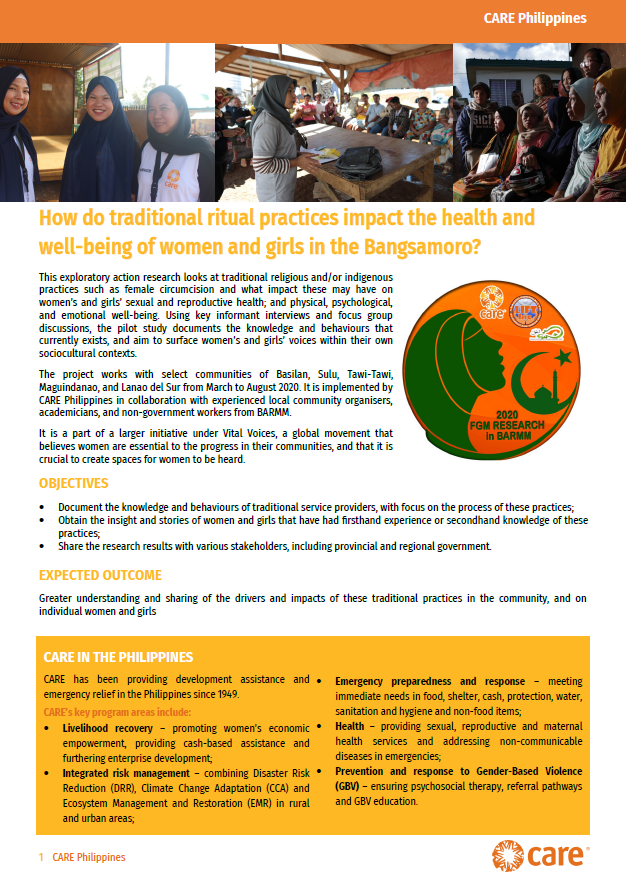
Project Briefer: Traditional Ritual Practices on Health of women and girls in the Bangsamoro
This exploratory action research looks at traditional religious and/or indigenous practices such as female circumcision and what impact these may have on women’s and girls’ sexual and reproductive health; and physical, psychological, and emotional well-being.
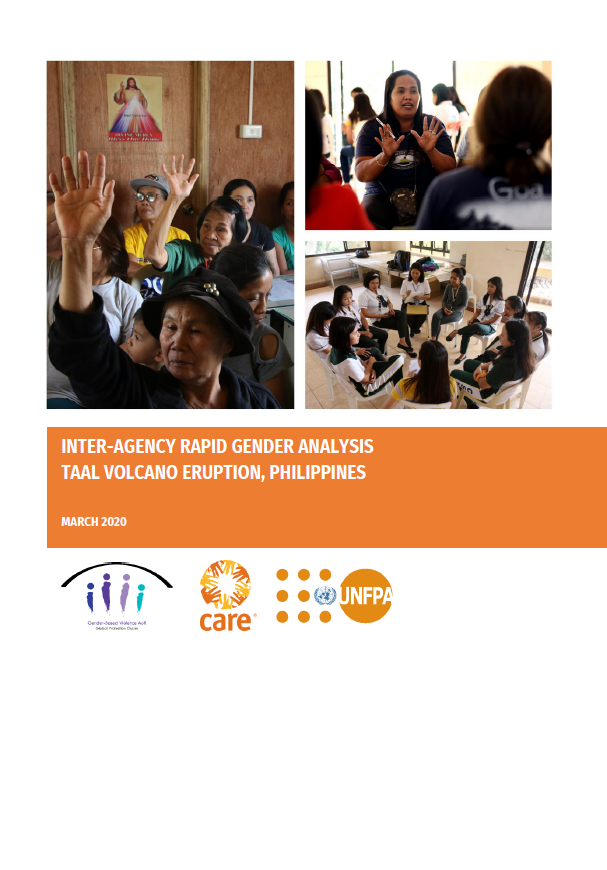
Report: Inter-Agency Rapid Gender Assessment
Rapid Gender Analysis (RGA) provides information about the different needs, capacities and coping strategies of women, men, boys and girls in a crisis. Rapid Gender Analysis is built up progressively: using a range of primary and secondary information to understand gender roles and relations and how they may change during a crisis.

Report: Soaring High, Self-Recovery through the Eyes of Local Actos
In 2017, CARE Philippines won a World Habitat Award in recognition of its 2013 Typhoon Haiyan shelter self-recovery programme. The programme supported 16,000 families to reconstruct their houses and make a number of important improvements after the said typhoon hit Leyte.

Brochure: CARE Philippines 2019
In fiscal year 2019, CARE implemented 19 projects reaching 135,983 directly and 2.06 million indirectly. CARE works closely with local organizations, cooperatives, and the private sector in implementing both emergency & development projects in the Philippines.

CARE Philippines Capacity Statement 2019
In fiscal year 2019 CARE Philippines has reached 135,983 people directly and 2.06 million indirectly through 19 projects.
Founded in 1945, CARE (Cooperative for Assistance and Relief Everywhere) is a leading global humanitarian and international development organization dedicated to defending dignity and eradicating poverty. CARE enables lasting change by strengthening the capacity of communities and households through social, political and economic opportunities, delivering relief in emergencies, influencing policy decisions, and addressing discrimination. For 75 years, CARE has led the way to a better life for the world’s most vulnerable people across 100 countries and 70 million people, each year.