
Caring for those who care: community health workers learn psychological first aid

Alabat, Quezon- When a neighbor falls ill, loses a loved one, or faces hard times, many Filipino families turn first to their barangay health worker (BHW). BHWs are community health volunteers in each barangay, the country’s smallest unit of local government. They check on families, share health information, and connect people to services. Yet the people who look after everyone else rarely get the chance to ask how they themselves are doing.
In the island municipalities of Alabat, Perez, and Quezon in Quezon Province, BHWs are making time for that question. On October, CARE Philippines trained BHWs from 15 barangays, five in each municipality, on mental health and psychological first aid (PFA). The training is part of the Integrated Health and Livelihood Program for Community Resilience Strengthening (I-HeLP) project.
Starting with themselves
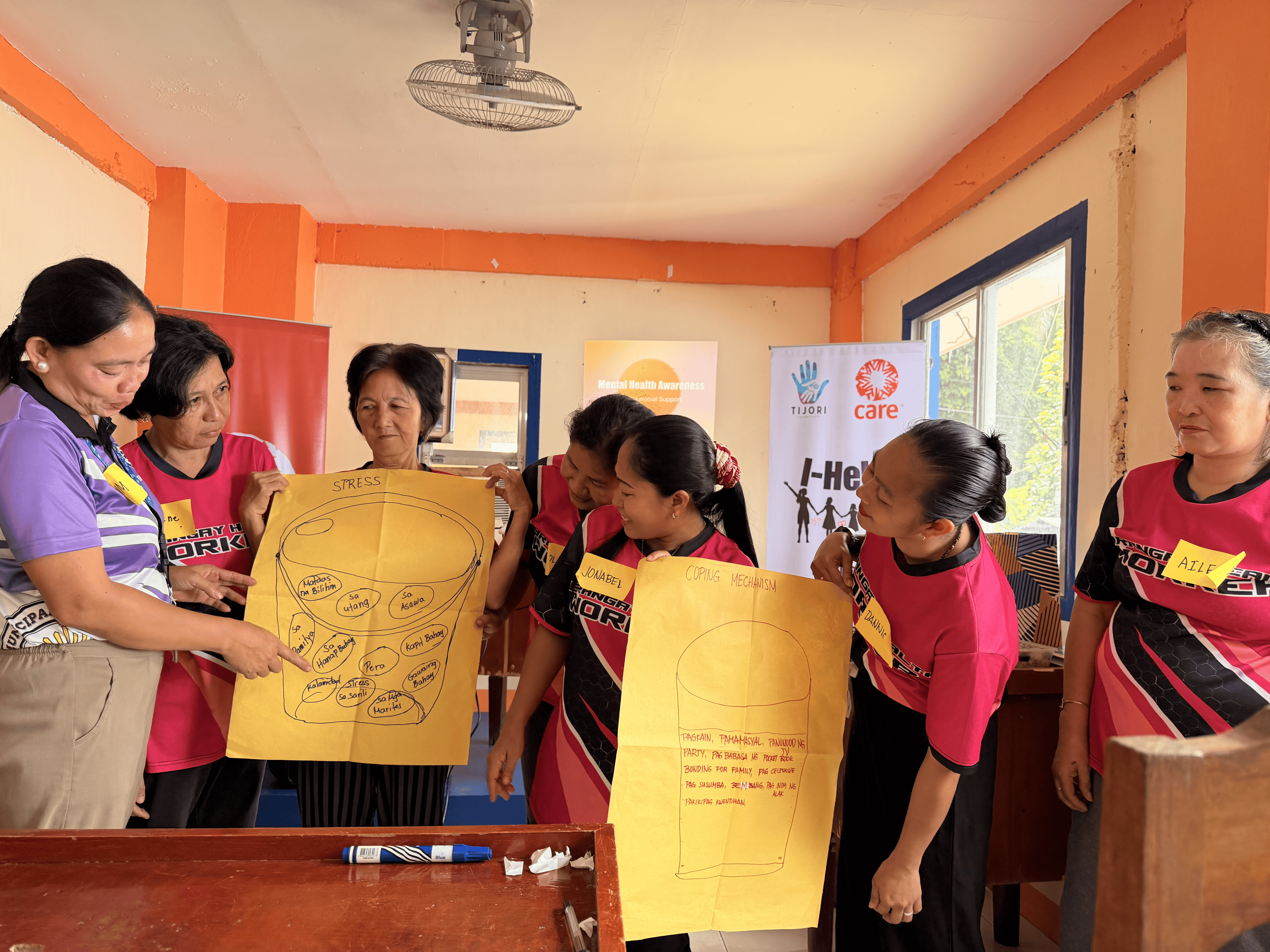
Photo: BHWs identify the factors of stress in one of the training’s workshops. (Shaira Lois dela Cruz/CARE Philippines)
The training put BHWs’ own well-being at the center. Participants talked about what mental health means in everyday life, how to recognize their own emotional needs, and why self-care matters for anyone who supports others. A session on stress and coping looked at how to recognize stress and handle it in healthy ways.
Danalyn, a Barangay Health Worker from Quezon municipality, said the session changed how she sees stress. “I learned that it’s normal to experience stress, but it can be reduced by resting, healthy thinking, managing your time, and talking with people you trust,” she said. “I also learned that it’s important to take care of yourself to maintain good health and emotional well-being.”
Practical help when people need it most
Participants also learned the basics of PFA. The World Health Organization (WHO) describes PFA as humane, supportive, and practical help for people facing distress. It is not counseling or therapy. Instead, PFA prepares community members to listen without pressure, help people feel calm and safe, meet basic needs, and connect them with more support.
A key part of the session was knowing when and where to refer people who need more specialized care.
“When BHWs are more aware, prepared, and supported themselves, they can help build a community that is not only physically healthy but also emotionally stronger and more resilient in facing life’s challenges,” said Shaira Lois dela Cruz, CARE health officer for I-HeLP.
What comes next
This first training introduces mental health and PFA as basic topics for BHWs in the three island towns. It also reminds BHWs that their own needs matter while they serve others. Next, the project will provide BHWs with kits of equipment for checking vital signs and monitoring noncommunicable diseases (NCDs), such as glucometers and high blood pressure monitors. With these kits, BHWs will set up NCD clubs in their communities as part of the project’s work on NCDs.
About I-HeLP
I-HeLP helps families in the island towns of Alabat, Perez, and Quezon stay healthy, earn income, and recover from typhoons and other crises. CARE Philippines runs the 24-month project with support from the Tijori Foundation. Started in November 2025, it aims to reach about 4,415 households, with a focus on women-led businesses, fisherfolk cooperatives, youth groups, people with disabilities, and small businesses. The project combines livelihood support, health and nutrition, mental health support, and planning led by communities themselves.
CARE. Always There.