Women and girls in the Philippines are in need of your support.

A Woman Leader in Building Resilience

“Have you ever felt so upset when all your hard work vanished in a snap?”

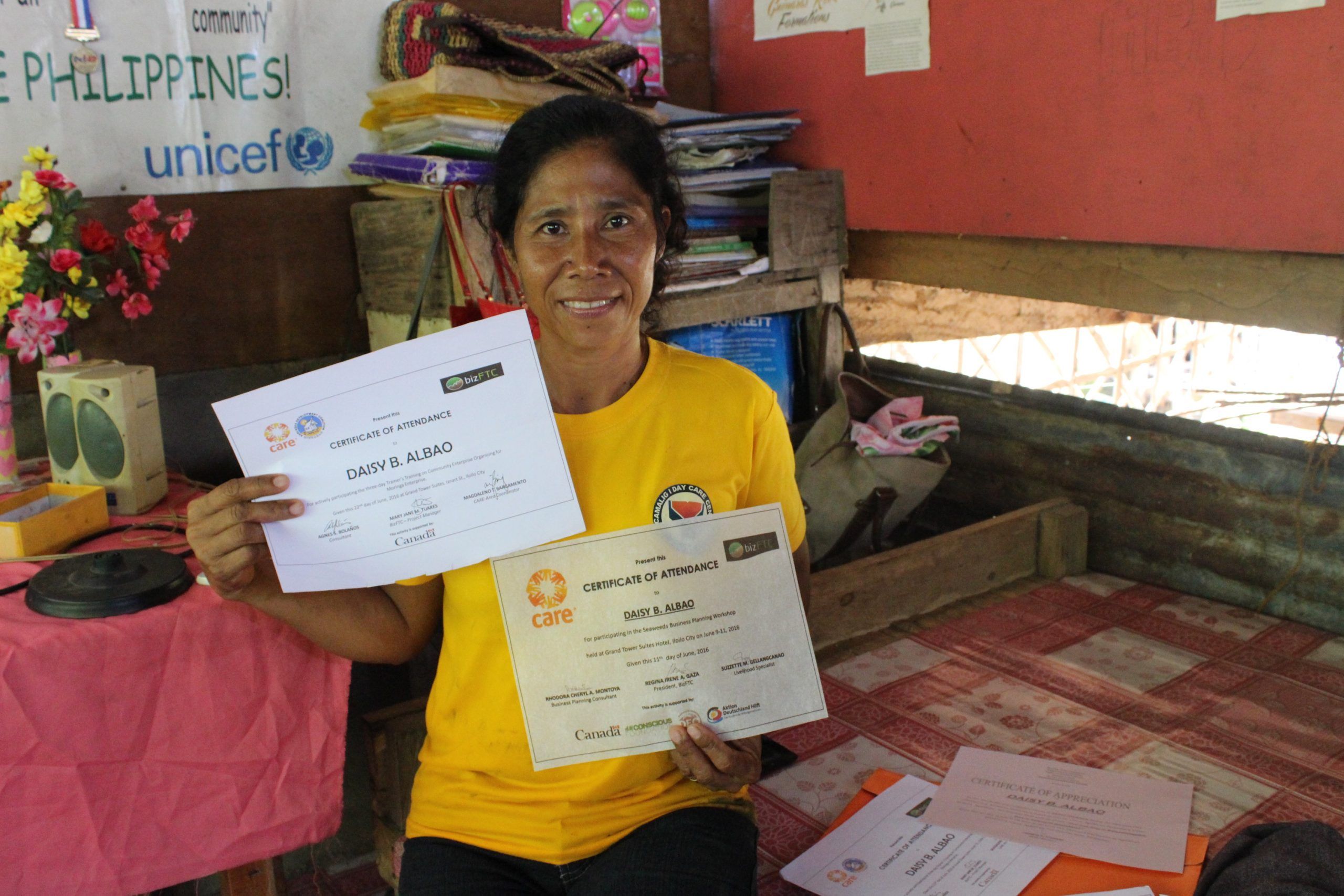
This was how Daisy Albao started when asked about the changes in her life after starting their own seaweed production enterprise. Whenever I interview people who took part in our livelihoods recovery project, they would excitedly share about their income, their savings and even things they were able to buy. But Daisy started with a different response.

Daisy, a 40-year-old mother of five is one of the most enthusiastic community leaders I know. She is the president of Agdaliran Women’s Rural Improvement Club Association (AWRIA), a women-led community organization in a coastal village in the town of San Dionisio, Iloilo province, Philippines.

AWRIA received cash grant from CARE to start a seaweed production enterprise after Haiyan’s catastrophic devastation. Through the Typhoon Haiyan Reconstruction Assistance project, financially supported by the Government of Canada through the Global Affairs Canada, AWRIA has received further technical assistance to improve their association’s productivity and linkages.

During my first interviews with her, Daisy elatedly shared her association’s dramatic journey to recovery. Many of the women members were not used to working as they were housewives. But the livelihoods program provided income opportunities for them when they started harvesting fresh seaweeds and selling the dried ones.

AWRIA has also received trainings from CARE and its partner Taytay sa Kauswagan Inc on enterprise management, financial literacy, productivity and marketing. AWRIA’s seaweed production was also badly affected by this year’s El Nino but they continued working to recover.

Daisy has become one of CARE’s Community-based Development Facilitators (CBDF) after displaying great interest in sharing knowledge to and serving other vulnerable people affected by typhoon Haiyan in 2013. She became instrumental as she conducted the same trainings she received from CARE in other remote villages. Her expertise in the local dialect as well as familiarity with the town’s culture really helped in effectively conveying important messages to CARE’s project participants.

But what exactly happened?

“One peaceful night before going to bed, my family and I heard strong waves from the sea. We knew that it was strange. The waves were louder compared to what we usually hear every evening. But then we still ignored it and went to sleep,” she said.

Daisy visited their seaweed plantation early in the morning but to her surprise, everything was destroyed. Their seaweeds and stilts supporting monolines were washed away. The women members gathered in dismay, all staring blankly at the endless stretch of water in front of them.

According to the Bureau of Fisheries and Aquatic Resources (BFAR), the coastal villages of San Dionisio experienced a wave surge (locally known in Iloilo as ‘pugada’) that night. A wave surge is a weather disturbance associated with the above normal rise of water level in open coast due to wind stress action on the water surface.

“There was no storm, it wasn’t even raining so we were shock to see that almost 95% of our seaweeds were gone. Our production intensely decreased,” shared by Daisy. “Our members were obviously frustrated and asking me what would be our next step.”

Daisy realized that they shouldn’t remain hopeless and still could do something about it. “I told my members that we would replant. We were able to save some seaweeds and we could start from the remaining 5%. But I know it wouldn’t be an easy ride,” said Daisy.

Daisy had a difficult time convincing the members to join her in replanting. And most of them just shook their heads to say no. But the association’s treasurer tapped Daisy’s back and told her she would help to convince others.

“I am really thankful to Jessica, our treasurer. She helped to talk to our members. Since we were able to generate savings from our income, we eventually had a group meeting and had an agreement to push things forward.”

CARE connected AWRIA to BFAR for technical assistance. The association even received additional planting materials from BFAR. The Municipal Agriculturist also came to the rescue to help the affected coastal villages.

“CARE also helped us to avail our crop insurance from the government. At least now we are less worried whenever we experience these weather disturbances,” shared Daisy.

The women of AWRIA are aware of the changing climate. They said they experience stronger waves during rainy season, and long dry spell also affects their seaweeds when seawater becomes warmer.

“We learned from the previous El Nino when our seaweeds were affected by the ‘ice-ice’ disease and now we also learned from this recent experience. We are very thankful for all the knowledge and techniques we’ve got from technical experts,” said Daisy.

Daisy and her members have learned from BFAR and CARE various agricultural techniques and practices to adapt to the changing climate, and mitigate the impact of disaster. They continued replanting and working together to recover.

“It was a good decision to never give up. For us, resilience doesn’t always mean succeeding in every action. It means being able to stand when situations cripple you for a moment”, said Daisy.

Story by Dennis Amata (Communications and Knowledge Manager, CARE Philippines)

Glimpse of light after the battle in Marawi

Story by Jerome Lanit, Emergency Coordinator, CARE Philippines

After days of hearing non-stop gunshots, bombings and agonies from people affected by the bloody armed conflict in Marawi City, 77-year-old widow Dipumbae finally saw a glimpse of light. On early Wednesday morning of September 27, she patiently waited for her turn to receive cash assistance given in a village in Lanao del Sur where she temporarily stays with her family.

On 23 May 23 2017, a group of Islamic State (ISIS)-associated militants locally known as Maute Group mercilessly invaded Marawi City in Mindanao, south of Philippines. The militants burned homes, hospitals, churches, schools, mosques, and shot everyone who stood against their way. According to reports, the Maute Group’s primary objective was to establish the first ISIS caliphate in Southeast Asia.

More than 300,000 people were affected and displaced when government forces waged an all-out war against the Maute Group. Government troops were able to exterminate key militant leaders and rescued innocent people and hostages from the battle zone. There were clashes between the troops and terrorists at some parts of the city leaving many residents including Dipumbae unable to return to their homes.

In response to the Marawi crisis, CARE, in partnership with Agri-Aqua Development Coalition Mindanao (AADC) and Al Mujadilah Development Foundation (AMDF), provided cash assistance to home-based internally displaced people (IDPs) and some host families. These IDPs escaped the armed conflict by staying with relatives or friends in a safer location.

“It is really difficult for me to stay in someone else’s home. I really miss my house. Now we have to depend on relief assistance to survive as we don’t have livelihood here to buy food and things we need,” shared Dipumbae.

“I have a total of ten children and grandchildren with me and often struggle to support our basic needs every single day. My relative is also poor and it pains me to see that we also add to their burden,” she added.

Dipumbae couldn’t help but cry whenever she thinks of her house in Marawi and their current situation. Their normal lives were disrupted and her grandchildren couldn’t go to school.

“Marawi City is no longer a city and looks like an ancient ruin. Devastation is everywhere,” describes AMDF staff Linky who is also from Marawi.

“Marawi was a sprawling urban city but now it’s far from being that. I just hope that we still have a house to return to because apart from the constant bombing and looting, burglary has become a problem now.”

“The government and other humanitarian actors should also support the affected population to recover or else a new breed of Maute Group will surface to demand retribution,” she continued with great worry and tinge of uncertainty for the future.

After receiving cash assistance from CARE and its partners, Dipumbae said she allotted a portion of it for her grandchildren’s school fees. Some would be spent for medicine and the rest is for buying fresh food like vegetable and fish.

“I am very grateful to CARE because they have given us cash assistance, we can now buy those important needs of our family and fresh food,” she added.

Dipumbae has the same concern echoed by women IDPs from Marawi. She said that affected women like her would need assistance on livelihoods recovery so that they would no longer rely on aid and have the capacity to provide for themselves.

“I had a small retail store in Marawi but it was destroyed after the conflict. All I need is a little capital to start over. Even if I no longer have that space, I will just find another one,” Dipumbae said.

“Women affected by the crisis are suffering but we need to remain strong for our families. We don’t have money for medicines and hospitalization in case we get sick. We need to take good care of ourselves amidst challenging living conditions and keep our children, surroundings, and bodies clean to avoid any illness.”

With the Marawi crisis slowly winding down, all eyes are set on recovery. CARE and its partners in Mindanao are committed to provide life-saving and early recovery support to the displaced population.

Livelihoods recovery assistance involving women, psychosocial & sexual reproductive health support to affected families through ‘Family Conversation Sessions’ and also shelter repair will be CARE’s top priorities as affected people slowly pick up the pieces towards recovery.

*Due to the sensitivity of the topic, Dipumbae doesn’t want her full name to be disclosed nor her photo to be used.

Photo credit: Al Mujadillah Foundation

Calling for innovative ideas

A Consortium of humanitarian organizations composed of CARE, Plan International, Action Against Hunger and Citizens Disaster Response Center is now calling for IDEAS for its TUKLAS Innovation Labs project! Everyone can pitch innovative and inclusive ideas related to disaster preparedness that will benefit poor and vulnerable communities in the Philippines. And when we say everyone, it’s actually EVERYONE. It could be an individual, a team, a social enterprise, a farmers’ association, a women’s group, a team of inspired millenials etc.

Sign up at www.bit.ly/tuklasdotph  and follow TUKLAS Innovation Labs on Facebook for more information and updates.

About the Project: The TUKLAS Consortium led by Plan International in partnership with Action Against Hunger, the Citizens Disaster Response Centre, and CARE will implement a 21-month project to reach across the country to foster and facilitate innovative ideas and entrepreneurs, taking a user-centred approach to nurture, test and scale promising models to addressing the gaps to improved emergency preparedness in the disaster prone country. The Innovation Lab project will be implemented from 1st July 2017 to March 31st 2019 with labs/teams in Baguio, Manila, Tacloban, and Cotabato.

The Philippines TUKLAS Innovation Lab will support innovators to test and refine their innovations through an iterative approach geared to regularly review, gain community feedback, promote continuous improvement and evaluate for continue viability/promise. A pipeline of 20 – 40 projects will be identified and supported under ‘scaling’ and ‘piloting.’ The project will invest in the entrepreneurs as change agents, working with them to develop a capacity building programming to expand their ability to be leaders in disaster preparedness.  Operating four community labs as ‘co-working’ spaces, the project will offer a platform for innovation and a mechanism to identify and further invest in innovations coming from the grassroots.  The project will take all efforts to creatively and meaningfully engage non-traditional actors in preparedness from academia and the private sector.

This project is part of a wider programme being managed by the UK-based START Network’s Disaster Emergency Preparedness Programme. It will therefore also work in collaboration with the Network, its Innovation Lab partners, and the other 3 selected Innovation Hubs.

A Solid Foundation: Building stronger and safer houses for typhoons

Story by: Dennis Amata (Communications & Knowledge Manager, CARE Philippines)

Now with typhoon season already approaching the Philippines, the worry of people living in rural areas starts to grow. In the remote and agriculture-dependent village of Balagan in Santo Nino, Cagayan, the people have a different response.

While the strength of typhoons continues to intensify because of climate change, residents of Balagan in Northern Philippines know that appropriate preparation is key to minimize impact of disasters. The village is considered prone to flash floods because of its proximity to huge Cagayan River, the longest and widest river in the country. The village was severely hit by Typhoon Haima (locally known as Lawin) in October 2016 leaving people with damaged rice fields and destroyed houses.

“It was the strongest typhoon we’d experienced! My house wasn’t even spared and I wasn’t able to save my belongings,” shared Jocelyn Ancheta, a 48-year-old farmer who completely lost her house after the raging waters of Cagayan River swept it away.

Jocelyn used to live a few meters away from Cagayan River which is considered a danger zone. She later realized that she should have listened to warnings before the typhoon hit.

“Life after the typhoon was extremely tough. We lost our house and the rice fields were all damaged. We were about to harvest and we couldn’t help but witness how the destructive typhoon took our livelihoods away in a snap,” added Jocelyn.

Also living in Balagan for decades, Remedios Allorda also lost her house after the typhoon. Remedios, a 75-year-old widow, lives alone in her house since all of her children have their own families already.

“I immediately evacuated to my son’s house when I felt that that typhoon was getting stronger. The next day when I rushed to my house, I saw that it was totally destroyed. My roof was blown off and all of my clothes and personal things were washed out,” said Remedios.

CARE, in partnership with Cagayan Valley Disaster Response Center (CVDRC) immediately responded to the needs of the affected people in six remote villages in Santo Nino, including Balagan. Through the financial support of the Government of Canada, CARE provided cash assistance (128 CAD per household) that could be used for both construction labor and procurement of necessary repair materials.

Also, CARE conducted “Build back safer” (BBS) sessions with local carpenters and members of the community to help them build disaster-resilient houses. They were taught construction techniques such as proper bracing and roofing, using strong joints, building on strong foundations and safe locations. These techniques gave the project participants awareness and knowledge on how to make their houses safer and more durable. Tarpaulins and posters about the BBS key messages in Filipino language were also hung in strategic locations in the community.

The recipients of the support were also given the decision to buy materials based on their specific needs and to address BBS requirements. They were also able to save money on transportation and hauling of shelter materials when they procured as a group from a single supplier. The group was also able to negotiate for free delivery of shelter materials to their community and received other discounts due to their bulk order.

CARE and CVDRC also organized a “Shelter Roving Team” composed of a community mobilizer and two trained

carpenters who would go around and check the progress of the repair or construction in the community.

“We visited the houses daily to check if they (project participants) were able to apply the BBS principles. Some households were able to build less than a month while others took some time because of the availability issues on some materials and additional funds,” said Jocel Ramos, roving team member.

“What’s good about our community is we practice mutual aid and cooperation or what we call ‘bayanihan.’ We helped each other during the repair. Some provided free labor while others also shared some extra materials to those who are in need, especially to older people and single mothers,” added Jocel.

CARE, in partnership with Cagayan Valley Disaster Response Center (CVDRC), immediately responded to the needs of the affected people in six remote villages in Santo Nino, including Balagan. Thanks to financial support from the Canadian Humanitarian Assistance Fund, CARE provided cash assistance (CAD $128 per household) to be used for both construction labor and procurement of necessary repair materials.

CARE also conducted “Build back safer” sessions with local carpenters and members of the community to help them build disaster-resilient houses.

CARE and CVDRC also organized a “Shelter Roving Team” composed of a community mobilizer and two trained carpenters to check the progress of repairs and construction works in the community.

“We visited the houses daily to check if they (the project participants) were able to apply the build back safer principles. Some households were able to build less than a month after the typhoon,” said Jocel Ramos, a roving team member.

Jocelyn decided to build a new house in a much safer location after attending the sessions. She learned about techniques and jointly worked with her husband to ensure that these were applied in their new house.

“Now I feel more comfortable in our new house. I can sleep soundly every night. Whenever we experience strong rains, I am more self-assured that this house will be able to withstand,” shared Jocelyn.

Join the fight.
Sign up for our mailing list.