Women and girls in the Philippines are in need of your support.

  • Home
  • Mary Therese Norbe

Author: Mary Therese Norbe

Conflict-affected community in Basilan receives aid thru CARE, partners

  • Mary Therese Norbe
  • Blog, Disaster Response, Featured Stories, Press Release

CARE Philippines Emergency Coordinator, Jerome Lanit hands over food items to a woman head of a household that was affected by the armed clashes in Ungkaya Pukan town in Basilan. (J. Dulla/CARE Philippines)

Five hundred eighty (580) households that were affected by the series of armed clashes in Brgy. Ulitan, Ungkaya Pukan, Basilan received essential food, non-food items, and shelter kits on February 4 and 5.

Members of these households were forced to leave their homes when combatants of the Moro Islamic Liberation Front (MILF) and the Philippine military clashed in November last year. When the conflict subsided, they returned only to find that some of their houses, including the mosque, madrasah, and an essential government building, were damaged from the fighting.

Some of the members of 120 households whose houses were damaged due to the fighting received shelter repair kits. (J. Dulla/CARE Philippines)

CARE and its partner, NISA Ul Haqq fi Bangsamoro, Inc., with the facilitation of the GPH-MILF Coordinating Committee on the Cessation of Hostilities (CCCH) and the Ad Hoc Joint Action Group (AHJAG) and with the support of the BARMM Ministry of Social Services and Development were able to access the community to deliver life-saving assistance to the affected vulnerable households.

“As humanitarians, it is important that we address first the needs of the members of vulnerable communities who still feel insecure because of the uncertainty of the situation while the peace mechanisms are working for a sustained solution to the conflict,” said Jerome Lanit, CARE’s Emergency Coordinator.

Meanwhile, Shalom Tillah Allian of NISA Ul Haqq fi Bangsamoro, Inc. shared that the collaboration with the BARMM MSSD, MILF CCCH and AHJAG showed that humanitarian and peace building efforts work meaningfully when working together on an equal footing.

“More than just the goods shared to them, to us what is more powerful is to see the mujahideens and the mujahidat owning the initiative as they led the distribution. We cannot overemphasize the importance of cultivating solidarity with the peace process mechanisms afforded to us”, she added.

Photos: Members of the community helped in the repacking and distribution of the relief goods to the affected households. (J. Dulla, S. Allian)

The Basilan Emergency Response is supported by the Tijori Foundation and is being implemented by CARE Philippines and its partner, NISA Ul Haqq fi Bangsamoro, Inc., in collaboration with the BARMM Ministry of Social Services and Development, GPH-MILF Coordinating Committee on the Cessation of Hostilities (CCCH) and the Ad Hoc Joint Action Group (AHJAG).

Farming, sewing, and saving

  • Mary Therese Norbe
  • Blog, Featured Stories, Latest News & Stories, Women and Girls

Dark clouds hovered when Lolita, 53, arrived at her house on a gloomy December morning. She had just finished her daily trek of the muddy trail to and from their vegetable farm in Brgy. Malabanan, Balete, Batangas. It had been raining for a few days, so she and her son, who works with her on the farm, constantly checked how their crops were faring with the weather. They learned to be meticulous in monitoring their crops, especially the vegetables, because of their experience with the Mt. Taal volcanic ash eruption earlier that year.

The string beans they planted were already in their first month of growth when it happened. The leaves turned yellow and were laden with small holes.

“We immediately applied fertilizer to help the crops withstand the effects. It did help them from withering and grew to produce string beans that were shorter and thinner”, shared Lolita. Their few kilos of harvest only paid for a part of the expenses they made for that cropping.

Lolita has been farming for the past thirty years. She shared that the challenges have become more difficult in recent years. The biggest hurdle was the unpredictable weather which greatly affected their planting schedule and their crops’ resilience to the intense heat in the dry season and the heavy rains in the wet season. Added to this was how traders controlled the market: which crops to produce and the price of these crops.

These are the seeds of pigeon peas locally known as kadyos which Lolita stored for planting. | Photo: M. Norbe/CARE

“We used to plant different varieties of vegetables. We had no choice but to stick to only those the market demands”, shared Lolita.

With most farmers doing the same, the supply increases every harvest. This leads to a decrease in the buying price for their crops.

When she attended one of the sustainable agriculture trainings organized by CARE and the Southern Tagalog People’s Response Center – STPRC, Inc., she learned that food producers like her should be innovative in navigating the tricky waters of the market and ensuring that their farm production will be sustained for future generations.

Her son, Reymark, 27, is already working on their farm, and Lolita wanted him and his family to continue reaping the benefits of farming. These training were part of the aGAP (Asenso sa Good Agriculture Package), a project supported by the Metrobank Foundation that assists marginalized farming households whose livelihoods have been doubly affected by the COVID-19 pandemic, and the intermittent Taal Volcano eruptions since January 2020.

After the training, she decided to integrate natural ways of farming by making oriental herbal nutrients (OHN), fish amino acids (FAA) and fermented plant juice (FPJ) and applying these as fertilizers and enhancers to their crops. Her first harvest after this was a success. The string beans yielded more than their usual harvest. The fruits were also longer and firmer. She also noticed that the soil turned darker, and the flowering vegetables kept blooming and bearing fruits every week.

Lolita (left) and another farmer participant peeled garlic to make oriental herbal nutrients (OHN) used to boost plant growth. | Photo: STPRC

She also decreased their production of ampalaya (bitter gourd), which sells at a high price but requires intense labor and is very sensitive to changes in weather and soil conditions and recurrent volcanic ash eruptions. Instead, she focused their vegetable production on crops that were easy to grow and required less amount of capital. She continued storing seeds that were open-pollinated varieties like string beans, okra, pigeon pea and winged beans, so she didn’t need to buy these from traders.

“We are near Taal, and we had to find ways like these to survive the effects of its eruption on our crops and livelihood,” she said.

Hence, Lolita also doesn’t depend on farming as her family’s sole source of income. After doing her farm chores, she sewed school uniforms that retailers of ready-to-wear clothes would buy from her for 130 pesos (2.6 USD) per dozen. She usually finishes two dozen per day. She also works on other farms as a weeder and harvester.

Above photo: Lolita spends most of her time in her porch where she sews school uniforms after her tending to their vegetable farm. |
M. Norbe/CARE

Right photo: Part of income from selling this fresh harvest of string beans will be put in the tin savings bank. | STPRC

“It felt so good to have some cash to use in times of difficulty. I didn’t have to borrow from anyone”, she added.

This story is part of the aGAP (Asenso sa Good Agriculture Package) sa Batangas implemented by CARE and its partner, Southern Tagalog People’s Response Center – STPRC, Inc. in three barangays in the Municipality of Balete in Batangas province. The Metrobank Foundation supports this project.

The Family Farm in Dinagat Island

It started drizzling when husband and wife Francisco, 40, and Jean, 33, finished weeding the vegetable plots at their two-hectare family farm up a hill in Brgy. Sto. Nino, Libjo, Dinagat Island. Francisco’s mother, Anastacia, 63, rushed and joined them to take shelter under a tent where their farmhouse used to stand before Typhoon Odette (Rai) flattened it to the ground. The lumber piled beside the tent was the only remaining reminder of the severe damage that the typhoon caused to their house and their farm. All the crops they lost were replaced with bananas, coconuts, corn, rice, cassava, taro, sweet potatoes, and various vegetables.

Jean shared that it took them a long time to regain the farm’s productivity. The flood and mud washed out all their stored seeds and farm tools. They had to build a temporary shelter down at the village to be close to their relatives and to any assistance they could access. It took more than a month before help came because the roads were difficult to pass due to the mud and debris. Within that period, their family relied on the remaining undamaged root crops they gathered from their farm for food.

When the government released financial assistance worth 5,000 pesos (100 USD), they immediately bought what they needed to restart their production.

“We couldn’t continue to wait for more help because our farm was the only source of income and food we had,” shared Jean.

However, everything they needed was sourced outside of the island. The difficulty of transport raised the prices of commodities, and the family could only do so much with the amount they received. They started replanting bananas from the seedlings of mother plants that survived the typhoon. They also made a small garden and grew vegetables for consumption. On September 2022, they harvested 140 kilos of bananas that sold for 35 pesos (70 US cents) per kilo. Even with this income, they knew it would take a considerable amount of money to get the farm back to produce crops for the market.

Then on October 2022, they were invited to a consultation and were selected as participants in the livelihood recovery project implemented by CARE and its local partner, ACCORD. Through the support of the US Agency for International Development’s Bureau for Humanitarian Assistance (USAID-BHA), their household received 15,000 pesos (300 USD) as assistance for them to use in their livelihood recovery.

They used the amount to hire farm workers to help them clean and prepare the soil for planting. Francisco bought fertilizer and vegetable seeds and started planting them for consumption and selling in the market. They planted okra, sweet potatoes, string beans, green peppers, snow cabbage (pechay), Malabar spinach (alugbati), and spring onions. These vegetables are cultivated easily. Hence, they were able to harvest and earn 2,000 pesos (40 USD) in the first picking.

Francisco picks okra for their family’s dinner. | M. Norbe

“It felt good to be able to earn again after the losses we had because of (typhoon) Odette,” said Anastacia, who missed the time when they were netting at least 4,000 pesos (80 USD) per week with their vegetables, corn, root crops, and bananas.

Anastacia (left) and Jean (right) show the vegetables that they grow in the family farm.

But with the state of their farm slowly returning to what it was before the onslaught, the family was hopeful that they’d be able to recover. They were expecting a massive harvest of sweet potatoes in December with an estimated selling point of 50 pesos (1 USD) per kilo.

“When we have saved enough, we plan to rebuild our farmhouse and return to living and farming here”, said Francisco who shared the difficulty of going uphill to the farm and downhill to their house at the village every day.

This story is part of the “Emergency Assistance to Support Local Recovery Capacity of Families and Communities Affected by Typhoon Odette”, an emergency response project funded by the US Agency for International Development’s Bureau for Humanitarian Assistance (USAID-BHA) and jointly implemented by Action Against Hunger Philippines and CARE Philippines and its local partner, ACCORD Incorporated.

The Vegetable Farm Up the Hill

  • Mary Therese Norbe
  • Blog, Featured Stories, Latest News & Stories, Stories of Change

It was nearly noon, and the sun was already scorching hot when Analyn, 48, picked string beans and snap peas on their 1.5-hectare vegetable farm up a hill in Brgy. Malabanan, Balete, Batangas. It was a grueling task because the trellises that held the vines up were bent low by the strong winds and rain brought by Typhoon Paeng (Nalgae) in September.  She crouched to get the mature beans while dragging a sack where she put her harvest. Her husband, Pablo, 54, picked okra on the other side of the farm. They then met where two large wicker baskets were nearly filled with the vegetables they gathered. They began sorting those of market quality from those they would cook at home or sell to their neighbors downhill.

While packing the vegetables they would sell to the traders in the market, Analyn shared that they are reaping the results of their good decisions at the start of the cropping season.

They were one of several small farmers affected by the volcanic ash eruption of Mount Taal that were invited as participants to CARE’s aGAP (Asenso sa Good Agriculture Package). It was a project implemented with the Southern Tagalog People’s Response Center – STPRC, Inc. with support from the Metrobank Foundation, Inc. that assists marginalized farming households whose livelihoods have been doubly affected by the COVID-19 pandemic and the intermittent Taal Volcano eruptions since January 2020. One of the project’s supports was providing additional farming inputs such as training on good agriculture practices to the participants to help them improve their resiliency to the constant volcanic ash and other climate change effects on their farming.

They learned from one of the sustainable agriculture training they attended that they could plant madre de cacao, a nitrogen-fixing tree, as natural trellises for their climbing vegetables. Their usual wooden post trellis cost 15 pesos each (27 cents). They needed at least 500 post trellises. Using the madre de cacao meant they saved 7,500 pesos (135 dollars). And because it is planted and growing, the tree can help prevent the soil from eroding, and its nitrogen-rich leaves can be used as fertilizer. With the trees rooted to the ground, they withstood being felled by the typhoon’s winds. Hence, the family was able to keep harvesting from their farm.

Moreover, Pablo learned to make fermented plant juice (FPJ) which ingredients were mainly from the plants they were growing. This is an inexpensive alternative to chemical fertilizers. They usually spend 4,000 pesos (72) dollars for fertilizer. With the FPJ, they partially cut the cost for this.

Pablo stirs the fermented plant juice (FPJ) that he made at home using molasses and vegetables harvested from the family farm. | Photo: M. Norbe

“We still couldn’t entirely turn it into an organic farm because we needed the yield that the chemical fertilizers bring. But slowly, we are noticing how the natural fertilizers I made produce healthier plants”, Pablo shared.

He had already experimented using only the FPJ and animal manure on a plot of okra, producing market-quality fruits. He planned to continue applying the knowledge from the training to the farm and see how they could improve their yield.

Pablo harvests okra from a vegetable plot where he experimented full application of fermented fruit juice (FPJ). | Photo: M. Norbe
The FPJ applied produced good market-quality okra fruits with minimal cost compared to chemical fertilizers. | Photo: M. Norbe

For farmers like Pablo and Analyn, yield is the most critical factor in bringing sufficient income from farming. However, their harsh experiences with the changing climate and the constant exposure to volcanic ash taught them that if they didn’t change their ways of farming, their land would continuously be stripped of its fertility and eventually lose yield.

They have been farming for the past 20 years using chemical fertilizers. They observed how these turned the soil so acidic that for every cropping, they added more to produce the same yield as the last. The soil gets easily eroded too, when heavy rains pour.  So, the couple are working hard to bring back their farm soil’s fertility and increase its resilience to extreme weather events by integrating good agricultural practices in their farming.

“We are getting older and we wanted to prepare this land for our son to inherit. When that day comes, this farm will be a thriving business that we hope for him to continue”, Analyn shared.

This story is part of the aGAP (Asenso sa Good Agriculture Package) sa Batangas implemented by CARE and its partner, Southern Tagalog People’s Response Center – STPRC, Inc. in three barangays in the Municipality of Balete in Batangas province. This project is supported by the Metrobank Foundation.

A Sweet Start

Madilyn and Leopoldo show a mixture of Filipino delicacies, muffins and waffles that they sell in Libjo, Dinagat Islands. | M. Norbe

Smoke rose from one of the houses and filled the air with a familiar delicious scent in the village of Plaridel, Libjo, Dinagat Islands. From the kitchen, Madilyn, 32, dipped into hot oil with brown sugar caramel the last batch of turon, a Filipino delicacy made of banana rolled in spring roll wrapper. She was rushing to cook before noon and bring her sweet delicacies to the local pier. It was December, and the port was bustling with activities because of the Christmas season. She, her husband Leopoldo, and their two children took this opportunity to sell Filipino sweet delicacies like turon, caramelized banana and cassava chips, steamed cassava cake, and rice cakes to several passengers and boat crew coming and going.

The trips are usually more than an hour long. These delicacies serve as snacks during the trip or as pasalubong, a homecoming gift brought by travelers to where they are going. Few people know how and have the patience to cook these native treats that Filipinos love to eat. Hence, Madilyn and Leopoldo turned their cooking into a business in the past twelve years.

“It’s a tedious process that takes long hours to be finished, but it also sells quickly,” said Madilyn.

Madilyn cooks turon in their kitchen to be sold at the pier. | M. Norbe

That was why they were relieved that they had resumed their business after their crops were damaged and all their cooking equipment was washed out by Typhoon Odette (Rai) in December 2021.

Leopoldo shared that they were still recovering from the losses that the COVID-19 pandemic caused when the port resumed its operations in May of that year. When the typhoon came, the cassava and bananas they were growing were felled by the strong winds. The flood washed out their cooking pans and steamer. Their kitchen was in complete shambles. Their house’s roof was torn off, and the walls were damaged. The couple shared that they didn’t know how they would start their lives after losing almost everything. On the first few days, they didn’t have anything to eat because the rice they had was soaked wet.

“But we couldn’t give up because we had children to feed, so we scoured for whatever food we could get,” said Madilyn.

Upon seeing that some cassava root crops from their neighbors’ farms survived, the couple’s entrepreneurial instincts kicked in. They asked their neighbors if they could harvest the remaining cassava and pay them only after they sold whatever product they could turn it into. Most farmers would only sell these to traders and didn’t know how to process these into edible products. Madilyn and Leopoldo boiled these and sold them until they earned enough to buy cooking pans and a fabricated steamer for cassava cake. Leopoldo would also gather firewood which saved them money from buying their usual charcoal.

They longed to plant their crops to decrease their expenses in buying from others. However, it would take a huge amount of money to prepare the soil for cropping. Then came the livelihood recovery project facilitated by CARE and ACCORD to their village. They were one of the families selected as participants in this livelihood recovery assistance from the USAID’s Bureau of Humanitarian Affairs. They immediately decided to use the money to finance their cassava cropping.  

“We bought soil enhancers and farm tools and hired a few people to help us in land preparation and planting more than 300 hills of cassava. We added the remaining money to our capital in cooking and selling delicacies”, Leopoldo shared.

It would take four months before the cassava could be boiled and eaten as an alternative to rice and a year to mature to be processed into cassava cake. While waiting for this, Madilyn and Leopoldo continue their business with the help of their children, who peddle their goods in places with a lot of foot traffic in their free time. They earn at least 200 pesos (4 USD) and at most 500 pesos (9 USD) daily, but they hope to increase their sales when schools start in January. With their sales, they have slowly repaired their house and bought additional cooking equipment like a waffle maker for business.

“It’s not always easy because most of us here are still trying to recover from the effects of the typhoon even after a year. In time, we will all be able to return to our livelihood fully”, added Madilyn.

This story is part of the “Emergency Assistance to Support Local Recovery Capacity of Families and Communities Affected by Typhoon Odette”, an emergency response project funded by the USAID’s Bureau for Humanitarian Assistance and jointly implemented by Action Against Hunger Philippines and CARE Philippines and its partner, ACCORD Incorporated.

Back to Fishing

Larry rests at the fishing dock after hours of fishing in Libjo, Dinagat Islands, Philippines.

It was near noon when Larry, 51, came back from five hours of fishing. He called on to his fellow fishermen resting at the fishing dock to help him haul his boat up. Larry was born with dwarfism. His short legs and arms made it difficult to carry his boat up when the water was too low for him to dock safely. Despite this, he shared that his life has always been fishing for the past 15 years in his small village of Osmena in Libjo, Dinagat Islands. This was why he couldn’t imagine how it would have been for him and his daughter had he not gone back to fishing after super typhoon Odette (Rai) severely damaged his boat’s hull.

He had been the sole provider for him and his daughter, Ladimar, who was also born with dwarfism. He yearned to go back to sea and fish, but it would take a huge amount of money to fix his boat. He shared that he used to catch an average of 5 kilos of fish, most of which he used to sell to fish vendors. He could provide food on the table and allowance for his daughter’s schooling. But the typhoon left him without means to earn. They relied on relief goods and monetary assistance from the government for months.

“I felt insecure because we didn’t know how long until the assistance stopped,” Larry shared.

CARE Philippines and ACCORD coordinated with the local government unit of Libjo to provide necessary assistance to the most affected households in their municipality. Larry was among those who could resume their disrupted livelihood with financial assistance from the USAID’s Bureau of Humanitarian Assistance (BHA). 

Larry paddles his new boat to fish which he bought using the financial assistance from USAID’s BHA. | Photo: J. Poliquit/CARE

He immediately bought a slightly bigger boat worth 10,000 pesos (180 USD) and used the remaining 5,000 (90 USD) to fix and repaint his damaged boat. He uses the bigger boat for fishing and the smaller one only for errands until it is completely sound for fishing. After months of being unable to go to sea, Larry is now back to fishing.

“I’m back to earning at least 2,000 pesos (40 USD) a week. It’s enough for us to buy a sack of rice and send my daughter back to school with an allowance”, he said.

Larry packs the fish he caught in an ice box. Most of these will be sold to fish vendors waiting at the dock. | Photo: J. Poliquit/CARE

Fishing is seasonal, and Larry shared that typhoon Odette (Rai) taught him a valuable lesson. When it happened, he was left without anything to take care of his family’s needs. These days, he strives to save part of his income in preparation for emergencies.

He shared that he felt nervous when December arrived this year. It brought back the trauma of the devastation that happened a year ago. “But I know what to do now to secure my house, boat, and fishing gear. I also have money saved to ensure that we can survive for days”, he shared.

But Larry and his fellow fisherfolks in Libjo continue to worry about their municipality’s fishing state. The changing climate has dramatically affected their source of livelihood. They had been experiencing lesser and lesser catches because of the unpredictable weather. Fisherfolks must venture far from shore to catch enough for the day.

Photo: Motorized fishing boats docked at a village port in Libjo, Dinagat | M. Norbe

In addition, they heard that the local government is planning to make an ordinance prohibiting fisherfolks from fishing within 50 kilometers of the municipal waters. With only a boat and paddle, Larry will not be able to go fishing that far.

Hence, he is saving little by little for a motorboat which would cost 50,000 pesos (895 USD). It would take time, he shared, but he could not give up on his livelihood until his daughter graduates and hopefully lands a job with sufficient income.

“I will continue to strive harder because it’s the only way I could give my daughter a good life.”

This story is part of the “Emergency Assistance to Support Local Recovery Capacity of Families and Communities Affected by Typhoon Odette”, an emergency response project funded by the US Agency for International Development’s Bureau for Humanitarian Assistance (USAID-BHA) and jointly implemented by Action Against Hunger Philippines and CARE Philippines and its local partner, ACCORD Incorporated.

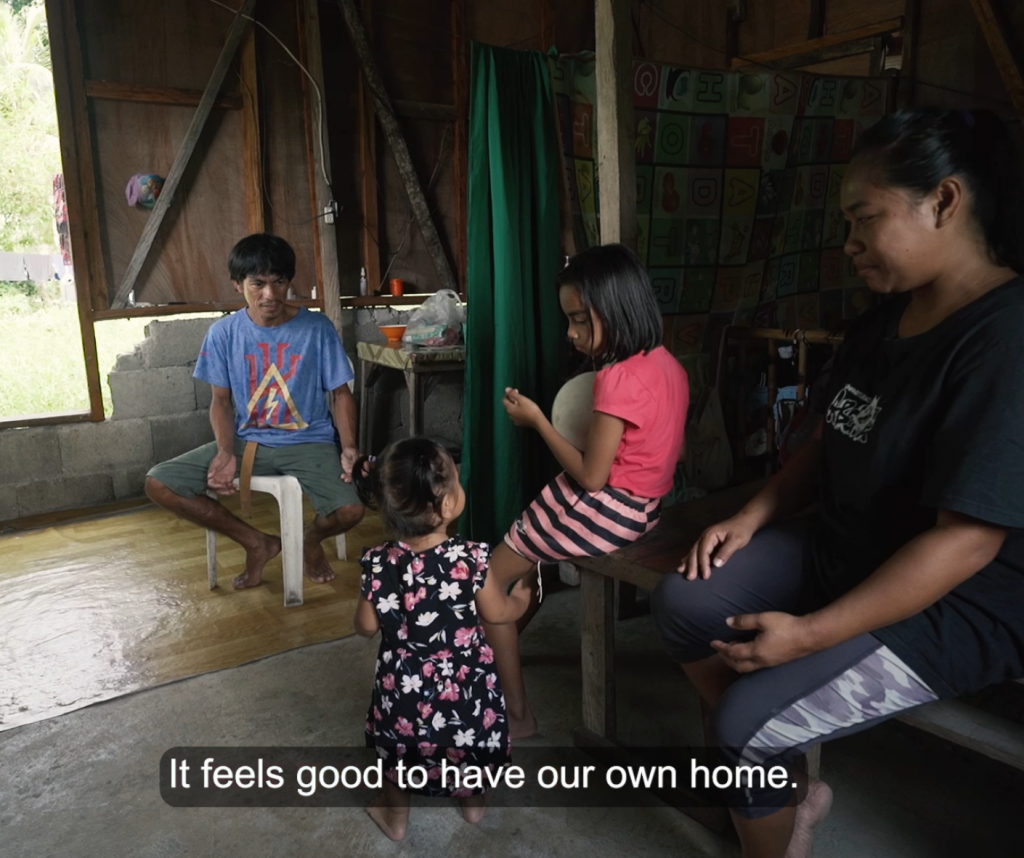
Balay (House)

A Girl’s Story of Loss and Hope

After Typhoon Odette brought her family’s house down, Precious, her parents and siblings are now enjoying the warmth and comfort of their house that was built to resist natural hazards such as storms, typhoons, floods, and earthquakes.

Watch her story here:

Precious’ parents Barney and Eunice shared that in the past two months, their new house withstood the heavy rain and strong winds that the rainy season brought in. Their CGI roofing was nailed and braced securely and was able to hold out against the wind. Their marine plywood walls were also braced for the wind and its material protected them from the rain.

Since #TyphoonOdette flew their roof off and took their bamboo walls down, Eunice said that they have never felt safe and secure until they moved into their new house.

“It rained heavily last night but we were confident that we would be safe because of how sturdy our house is”, she added.

The family was sheltered in the latter’s mother’s house after the typhoon until CARE and National Rural Women Coalition (PKKK) came to their barangay to support affected families in their efforts to repair or rebuild their houses.

Through the Immediate and Comprehensive Response for Communities Affected by Typhoon Rai in the Philippines, they were able to access shelter repair kits. The barangay also recommended their family be assisted in repairing their house through mutual help or the bayanihan system. Volunteer carpenters and other members of the community helped in the repair.

This is usually done when some members of the community such as the elderly, the sick, and persons with disabilities are not able to repair or rebuild their houses on their own. Barney said that his epilepsy prevented him from doing the construction, hence, he was thankful that his community helped his family.

He and his wife are presently managing a small sari-sari store and internet vending business in their house. They will also be supported by the response through livelihood enhancement training and addition to capital.

This response is being implemented by a consortium of partners including CARE, PKKK, ACCORD Incorporated, Action Against Hunger Philippines, and Plan International Philippines with support from the EU Civil Protection & Humanitarian Aid.

Communal gardens sprout up months after #OdettePH

  • Mary Therese Norbe
  • Featured Stories, Food & Nutrition, Latest News & Stories

Riza, 35, shows the vegetable seedlings that she and members of their group propagate in their nursery in Barangay Mahayahay, San Jose, Dinagat Island Province. Meanwhile, her 73-year-old mother, Matilde waters the plants in their communal garden where okra, string beans, peppers, squash, sweet potato, water spinach, and other vegetables are growing.

“We already harvested three times since we started the garden. It really helps especially at times when we don’t have enough money to buy food”, Riza shared.

She also said that they are growing their food using organic compost and fertilizers such as fermented fruit and plant juice which materials are sourced in their community.

Their members were trained in sustainable organic farming after Typhoon Rai (Odette) ruined their crops and stripped the garden soil barren.

Through the Immediate and Comprehensive Response for Communities Affected by Typhoon Rai (Odette), men and women members of their communities were organized and formed into mutual groups for reviving the former and engaging in alternative livelihoods.

Aside from their association’s dry goods stores, they decided to put up communal nurseries and gardens to ensure that food will always be on their table.

“After the typhoon, it was very difficult to find food. Now, when we harvest beans, we can store them both for seeds and food”, she added.

The Immediate and Comprehensive Response for Communities Affected by Typhoon Rai (Odette) is implemented jointly by CARE Philippines, ACCORD Incorporated, Action Against Hunger Philippines, National Rural Women Coalition (PKKK) and Plan International Philippines in Dinagat Islands, Palawan, Southern Leyte, Bohol, Negros Occidental, and Cebu, Philippines.

RISE Coco project to rehabilitate 700 hectares of 1,000 typhoon-affected coconut farmers in Bohol

  • Mary Therese Norbe
  • Featured Stories, Latest News & Stories, Press Release

Highlight of the activity is the signing of the Memorandum of Understanding (MoU) to work together towards the successful implementation of the project. From left: Mr. Gerardo F. Cuadrasal, Jr. , Municipal Administrator of Calape, Bohol representing  Hon. Mayor Julius Caesar F. Herrera; Hon. Mayor Diosdado Gementiza, Jr. of San Isidro, Bohol; Christopher Matthew Ilagan of Cargill; David Gazashvili of CARE Philippines and Mr. Brendan P. Trasmonte, Regional Manager III for Region VII, Philippine Coconut Authority (PCA)

Manila, Philippines (September 26,  2022) — Nine months since Super Typhoon Odette (Rai) felled over three million coconut trees in the province of Bohol, Cargill Philippines partners with CARE Philippines, Cebu-Bohol Relief and Rehabilitation Center (CRRC), and the Philippine Coconut Authority (PCA) to replant 100,000 coconut seedlings in devastated local communities through the RISE Coco (Recovery Intervention for Severely Affected Coconut Farming Communities of Bohol by Super Typhoon Odette) project. More than 10 million coconut trees were damaged in several areas nationwide and gravely affected farming families whose livelihood was dependent on producing copra.

farming families whose livelihood was dependent on producing copra.

The Bohol provincial PCA already pledged to initially replace felled trees with 500,000 dwarf variety seedlings in February. This variety takes three to four years to bear fruit compared to the hybrid variety which takes five years to yield. However, with no other means to provide for their families, farmers are already finding it difficult to bounce back while waiting for harvest. The available coconut seedlings were very limited and were allocated to only a few municipalities. To bridge this gap, coconut farmers supported by this project decided to establish their own community-based seed beds to propagate coconut seedlings for re-planting.

Through the RISE Coco Project, 1,000 coconut farming households in the municipalities of Calape, Catigbian, Loon, and San Isidro will be able to gradually recover and sustain their coconut farming livelihoods. The project focuses on replacing the damaged coconut trees, training the farmers on sustainable agriculture, providing alternative livelihoods while waiting for the coconut trees to bear fruit, and organizing the farmers into cooperatives to have better access to markets and corporate buyers.

The project was officially launched on September 15, 2022, at the Calape Forest Resort and was attended by almost 100 participants from the local government offices, PCA officials, Cargill, CARE, CRRC and farmer leaders in the province. As the first coconut disaster rehabilitation program in the province spearheaded by the private sector, the project is strongly supported by the provincial government of Bohol and the municipal mayors of the four covered municipalities. PCA, including its regional and provincial offices, also expressed commitment to provide technical assistance during the project implementation.

PCA Region 7 Manager Brendan Trasmonte acknowledged the critical and challenging role that the PCA will play in the success of the project as it needs quality seed nuts and seedlings and the technical knowledge of coconut farmers to sustain and expand their sources of income beyond coconut farming.   

This project partnership is anchored on a global agreement between Cargill and CARE International to work together to implement programs that would rehabilitate livelihoods impacted by disasters, support recovery and promote food security of affected farming communities.

“It’s our way of supporting the rehabilitation of the livelihoods of the coconut farmers of Bohol severely impacted by the climate-induced Supertyphoon Odette – the same coconut farmers who have been our reliable suppliers of copra over the years which we in turn crush at our General Santos City plant into world-class crude coconut oil,” said Cargill Philippines’ Corporate Affairs Director Christopher Matthew Ilagan.

Cargill’s Copra & Palm Origination Commercial Director, Jonathan Sumpaico added, “Cargill is committed to grow with the communities where we live and work.   The RISE Coco program, as part of our broader partnership with CARE Philippines, allows us to put that commitment into action by ensuring the farmers affected by the Supertyphoon produce sustainably grown copra and continue to benefit from responsible economic development as our partners.”

Meanwhile, CARE Philippines Country Director David Gazashvili sees the project as a way to develop the resiliency of coconut farming communities against the drastic effects of climate change.

“Farmers will be trained to increase their capacities to better prepare for disasters alongside local government structures. This implies ensuring the availability of food for their family and community and ability to cope and bounce back through other sources of income and immediate government support”, he said.

The RISE Coco project is led by CARE Philippines and is being implemented with CRRC with active participation from Cargill employees across all project areas.

Symbolic turnover of coconut seedlings to the farmer leaders of the coconut farming communities in the selected project sites.

# # #

About Cargill

Cargill helps the world’s food system work for you. We connect farmers with markets, customers with ingredients and families with daily essentials – from the foods they eat to the floors they walk on. Our team around the world innovates with purpose, empowering our partners and communities as we work to nourish the world in a safe, responsible, sustainable way. This includes 2,000 colleagues across 27 locations in the Philippines, where we’ve been working since 1948 to make our global vision a local reality. Visit https://www.cargill.ph/en/home to know more.

From feed that reduces methane emissions to waste-based renewable fuels, the possibilities are boundless. But our values remain the same. We put people first. We reach higher. We do the right thing. It’s how Cargill has met the needs of the people we call neighbors and the planet we call home for 157 years – and how we’ll do so for generations to come. For more information, visit Cargill.com and our News Center.

About CARE
Founded in 1945 with the creation of the CARE Package®, CARE is a leading humanitarian organization fighting global poverty. CARE places special focus on working alongside women and girls. Equipped with the proper resources women and girls have the power to lift whole families and entire communities out of poverty. In 2020, CARE worked in over 100 countries, reaching more than 90 million people through 1,300 projects. To learn more, visit www.care.org.

Humanitarian organizations to launch Typhoon Odette photo exhibit in Siargao, highlight need of survivors

  • Mary Therese Norbe
  • Blog, Featured Stories, Latest News & Stories, Press Release

Humanitarian organizations will be launching a photo exhibit in Siargao next week to raise awareness about the impact of Typhoon Odette (international name: Rai) and the concerted efforts of residents and various groups in rebuilding the affected communities.

The photo exhibition dubbed “The Last Mile,” which will open on August 15, 6 p.m. at the Siago Beach Resort in General Luna, Siargao Island, just a few days before the commemoration of the World Humanitarian Day (August 19).

The event is organized by non-government organizations and local government units working on the Typhoon Odette Response. The aim of the event is to urge the national government and other stakeholders to not forget those most vulnerable in times of disaster.

It will feature almost a hundred images captured by organizations who implemented the European Civil Protection and Humanitarian Aid Operations (EU-ECHO)-supported emergency response for the survivors of Typhoon Odette: ACCORD, Action Against Hunger, Care Philippines, Humanity & Inclusion, Initiatives for Dialogue and Empowerment through Alternative Legal Services (IDEALS) Inc., National Rural Women’s Coalition, Oxfam Pilipinas, Plan International, Save the Children Philippines, and Sentro para sa Ikauunlad ng Katutubong Agham at Teknolohiya (SIKAT) Inc.

European Union (EU) Ambassador to the Philippines Luc Veron will be giving a message at the opening event of the exhibit, followed by presentations by the participating organizations.

“We want to showcase these powerful images to show just how devastating typhoons are to marginalized and remote communities in the Philippines. We also want to show what we can do together to save lives and reduce the risks and impacts of disasters,” said Oxfam Pilipinas Country Director Lot Felizco.

“With climate change, we expect more intense typhoons to hit the Philippines. We hope the exhibit will also give people hope that something can be done and is being done to strengthen our communities against future disasters and to help them recover from Typhoon Odette,” she added.

CARE Philippines Country Director David Gazashvili said the exhibit will also show the achievements and challenges that residents and humanitarian organizations face eight months after the devastation of Typhoon Odette.

“The exhibit shows how the quick and substantial funding from the EU-ECHO, the power of communities, women and men, boys and girls working together and collaborating with humanitarian actors have effectively addressed urgent humanitarian needs, especially of those who need the most assistance. But it also brings to the surface the challenges of prioritizing disaster-preparedness, risk reduction, and climate change mitigation and adaptation,” he added.

EU-ECHO’s funding of the Typhoon Odette emergency response has enabled the provision  of emergency services to almost half a million individuals in Bohol, Cebu, Dinagat Islands, Southern Leyte, Negros Occidental, Palawan, and Surigao del Norte through the implementation of two consortia: one led by CARE, with ACCORD Inc., National Rural Women’s Coalition, Plan International, and Action Against Hunger; and another led by  Oxfam Pilipinas and jointly implemented by Save the Children and Humanity & Inclusion (HI), together with local partners SIKAT Inc. and IDEALS Inc.

The joint efforts of the groups resulted in the distribution of food and livelihood assistance to 70,643 individuals; water, sanitation and hygiene packs for 75,394; protection assistance for 147,549; shelter provision for 72,902; health services for 68,317; and “education in emergency” assistance for 41,205.

Besides attending the photo exhibit, the EU ambassador will also be visiting Pilar in Siargao Island to observe EU-ECHO-funded activities such as the “Education in Emergency” component of the project in Caridad Elementary School. As part of the Typhoon Odette Emergency Response, the school’s teachers received training, supplies and a multi-purpose learning space where “return to learning” sessions are being held. The consortium also assisted in the construction of the multi-learning space and the repair of the damaged classrooms, which will also be turned over next week

For the coming months, the groups will continue to provide the same support for the most affected communities in Bohol, Cebu, Dinagat Islands, Southern Leyte, Negros Occidental, Palawan, and Surigao del Norte.

###

FOR MEDIA INQUIRIES AND COORDINATION:

Kristine Sabillo Guerrero | Senior Officer for Media and Digital Influencing, Oxfam Pilipinas

Email: kGuerrero@oxfam.org.uk | Mobile: 09175691449

Join the fight.
Sign up for our mailing list.